Building a home is a significant financial commitment, and choosing the right location is one of the most important decisions you will make. However, not every attractive piece of land is suitable for residential construction, particularly when the area experiences seasonal waterlogging.
In several Nigerian communities, some residential neighbourhoods remain dry during the dry season but experience water accumulation whenever heavy rainfall begins. In some locations, the water disappears within a few hours, while in others, it may remain around buildings, roads, and compounds for several days.
Although seasonal waterlogging may not always be as destructive as severe flooding, it can create serious problems for homeowners. Persistent moisture can weaken building materials, damage foundations, encourage mould growth, affect accessibility, and increase property maintenance expenses.
For prospective homeowners and real estate investors, understanding these challenges before construction begins can prevent costly mistakes.
Whether you are planning to build a family house, develop rental apartments, or purchase land in a waterlogged neighbourhood, here are important things you should know.
1. Understand Why the Area Experiences Seasonal Waterlogging
Before purchasing land or commencing construction, investigate why water accumulates in the neighbourhood during certain periods of the year.
Seasonal waterlogging can occur for several reasons, including:
- Poor natural drainage.
- Low-lying land.
- Heavy seasonal rainfall.
- High groundwater levels.
- Clay-rich soil with poor water infiltration.
- Blocked drainage channels.
- Inadequate stormwater infrastructure.
- Water runoff from surrounding elevated areas.
Understanding the underlying cause is essential because not every waterlogging problem can be solved with the same construction approach.
For example, a property experiencing temporary water accumulation because of blocked roadside drains may require a different solution from one located in an area with naturally high groundwater levels.
Before investing, ask experienced residents about the history of water accumulation and whether the problem has improved or worsened over the years.
2. Investigate the Land During the Rainy Season
One of the biggest mistakes prospective property owners make is inspecting land only during the dry season.
A plot that looks perfectly suitable for construction in January may become surrounded by water during July or August.
This is particularly important in Nigerian locations where seasonal rainfall significantly affects drainage conditions.
If possible, visit the proposed building site during the rainy season or shortly after substantial rainfall.
Observe:
- Whether water accumulates on the land.
- How long the water takes to disappear.
- Whether neighbouring compounds experience similar problems.
- Whether nearby roads become inaccessible.
- Whether water flows towards or away from the property.
- Whether drainage channels overflow.
If visiting during the rainy season is impossible, speak with long-term residents and request photographs or videos showing the property’s condition during previous rainy seasons.
Never rely entirely on the appearance of dry land when making an important property investment decision.
3. Conduct a Proper Soil Investigation
The type of soil on your proposed building site can influence how water behaves and how suitable the land is for construction.
Some soils absorb water relatively quickly, while others retain moisture for extended periods.
For instance, clay-rich soil generally has lower permeability than sandy soil. This means water may remain near the surface for longer, depending on site conditions and drainage.
Before construction, engage a qualified geotechnical professional to conduct an appropriate soil investigation.
The assessment should help establish:
- Soil composition.
- Soil bearing capacity.
- Groundwater conditions.
- Soil permeability.
- Potential settlement risks.
- Appropriate foundation requirements.
This information is important because a foundation designed without understanding the underlying soil conditions may experience problems over time.
Do not allow a contractor to recommend a foundation design simply because it worked on another property in a different neighbourhood.
Every building site has its own conditions.
4. Consider Raising the Building Above the Surrounding Ground
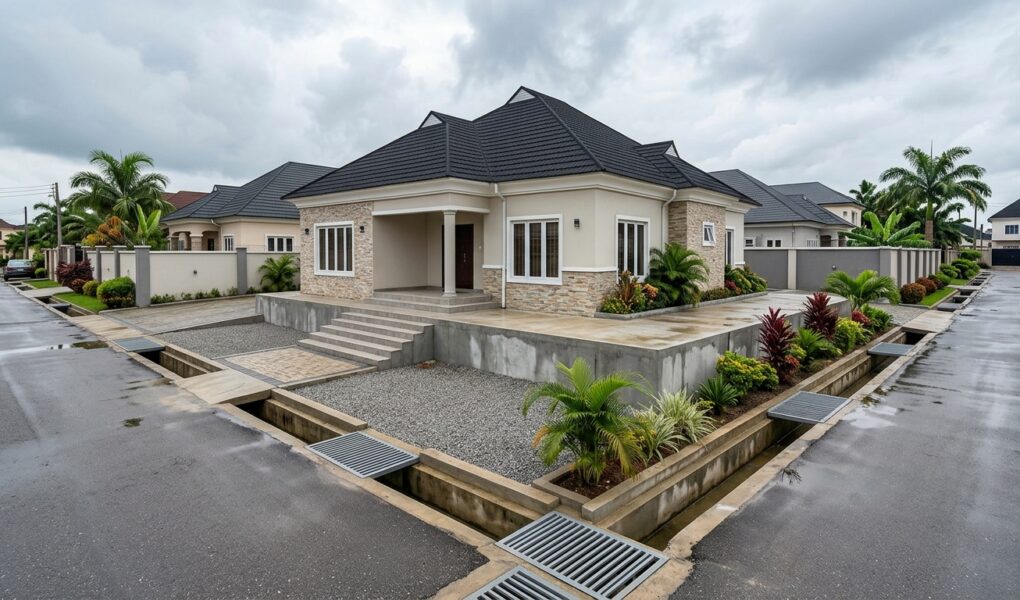
One construction approach that may be appropriate in waterlogging-prone locations is raising the finished ground-floor level above the surrounding terrain.
This can help reduce the possibility of rainwater entering the building during periods of water accumulation.
However, the required elevation should not be determined by guesswork.
An architect, civil engineer, and other relevant professionals should assess the site’s elevation, historical water levels, expected drainage conditions, and applicable flood-risk information.
Depending on the assessment, the design may incorporate:
- An appropriately raised building platform.
- Properly compacted and suitable fill material.
- Adequate foundation support.
- Carefully designed access steps or ramps.
- Suitable external ground slopes.
- Effective surface-water drainage.
It is also important to ensure that raising your building does not redirect water towards neighbouring properties.
A well-designed property should protect itself without creating drainage problems for the surrounding community.
5. Design an Effective Drainage System
Drainage is one of the most important elements of residential development in areas with seasonal waterlogging.
Even a well-constructed building can experience problems when rainwater has nowhere to flow.
Your property should have a drainage arrangement that directs water away from the building and connects appropriately to an effective discharge system.
Depending on the site, drainage solutions may include:
- Surface drainage channels.
- Properly designed underground drainage pipes.
- Perimeter drains.
- Suitable ground grading.
- Rainwater collection systems.
- Approved discharge connections.
- Properly positioned drainage outlets.
Avoid constructing drainage channels without considering the surrounding environment.
For example, directing water from your compound into a neighbouring property can create disputes and potentially worsen the area’s drainage problems.
A qualified professional should design the system based on the site’s actual drainage conditions.
6. Pay Attention to Foundation Design
Foundation selection is particularly important when building on land that experiences repeated waterlogging.
Prolonged moisture exposure can affect certain soil conditions, while erosion, soil movement, and poor compaction can compromise foundation performance.
Depending on the geotechnical findings and structural requirements, an engineer may recommend a suitable foundation system, such as an appropriately designed strip foundation, raft foundation, or pile foundation.
The correct choice depends on the soil’s bearing capacity, groundwater conditions, building loads, and other site-specific factors.
You should also consider appropriate waterproofing and protection against moisture entering the building through foundations and ground floors.
Do not assume that a deeper or more expensive foundation is automatically better.
The objective is to select a structurally appropriate and economically sensible solution based on professional investigation.
7. Choose Construction Materials That Resist Moisture
Homes in waterlogging-prone locations may experience more frequent exposure to damp conditions than properties in well-drained areas.
Therefore, material selection should account for moisture resistance and long-term durability.
Pay attention to:
Flooring: Choose suitable floor finishes that can withstand occasional moisture exposure and are easy to clean.
Wall protection: Use appropriate damp-proofing systems and finishes to reduce moisture penetration.
Doors and frames: Consider materials and protective treatments that are less vulnerable to swelling, rotting, and corrosion.
Metal fittings: Use suitable corrosion-resistant materials where necessary.
Roofing: Ensure proper roof installation and drainage to prevent additional water-related damage.
Electrical installations: Ensure that electrical components are installed and protected according to applicable safety standards, with particular attention to areas that could be exposed to water.
Remember that moisture-resistant materials are not a replacement for effective drainage and proper construction.
8. Protect the Building Against Rising Damp
Rising damp is a condition in which moisture moves upward through porous building materials, often from the ground.
In areas with persistently wet soil, inadequate damp-proofing can contribute to moisture entering walls and floor structures.
Signs of damp-related problems may include:
- Peeling paint.
- Damp patches on lower walls.
- White salt deposits on plaster.
- Musty smells.
- Deteriorating wall finishes.
- Damaged skirting boards.
During construction, discuss appropriate damp-proof courses, floor membranes, waterproofing details, and other moisture-control measures with your building professionals.
Proper detailing around foundations, floors, walls, and service penetrations is particularly important.
Do not wait until visible damage appears before addressing moisture protection.
9. Consider the Height and Condition of Surrounding Roads
Your building may be properly elevated, but what happens when the surrounding roads become waterlogged?
This is a problem many homeowners overlook when purchasing land.
A house may remain dry internally while residents struggle to enter or leave the neighbourhood during heavy rainfall.
Before developing property, investigate:
- The elevation of surrounding roads.
- Whether road surfaces collect water.
- The condition of nearby drainage channels.
- Whether vehicles can access the property during heavy rainfall.
- Whether pedestrians have safe access.
- Whether emergency vehicles can reach the neighbourhood.
Also consider the possibility of future road construction or rehabilitation.
A residential property should be accessible throughout the year, not only during the dry season.
10. Plan for Proper Compound Landscaping
Landscaping is not only about making your compound beautiful. It can also influence how rainwater moves around your property.
Poorly planned landscaping may create depressions where water accumulates.
When designing your compound, ensure that ground levels direct surface water away from the building.
Consider using suitable permeable surfaces where practical, allowing some rainwater to infiltrate the ground instead of directing all runoff towards drainage channels.
You may also incorporate:
- Properly graded paved areas.
- Suitable grassed sections.
- Rain gardens where appropriate.
- Controlled surface drainage.
- Properly positioned downpipes.
- Suitable rainwater harvesting arrangements.
However, landscaping solutions should be coordinated with the overall drainage design.
Planting grass alone will not solve serious waterlogging caused by high groundwater levels or inadequate drainage infrastructure.
11. Understand the Long-Term Maintenance Requirements
Building in an area with seasonal waterlogging may involve additional maintenance responsibilities.
Even when the property is properly designed, surrounding environmental conditions can create recurring challenges.
You may need to regularly inspect:
- Drainage channels.
- Foundation areas.
- External walls.
- Floor finishes.
- Roof gutters and downpipes.
- Septic systems and wastewater arrangements.
- External paving.
- Electrical installations.
Blocked drains, damaged pipes, and poorly maintained gutters can worsen water accumulation.
If you are developing rental apartments, include these maintenance responsibilities in your property management plan.
A building that requires regular attention should be evaluated based on its total ownership cost, not merely its initial construction expenses.
12. Evaluate the Impact on Property Value and Rental Demand
Seasonal waterlogging can influence how prospective buyers and tenants perceive a residential property.
Some people may avoid locations where roads and compounds regularly become waterlogged, even when the buildings themselves remain relatively dry.
This can affect:
- Property marketability.
- Rental demand.
- Negotiating power during property sales.
- Tenant retention.
- Maintenance expenses.
- Long-term investment returns.
However, the effect depends on the severity of the problem and the effectiveness of mitigation measures.
A neighbourhood with a history of temporary waterlogging may remain attractive if drainage infrastructure has improved and residential access is reliable.
Property investors should investigate actual market demand instead of assuming that every waterlogging-prone area will experience the same decline in property value.
13. Consider Water Supply and Wastewater Management
High groundwater levels can affect more than foundations and surface drainage.
They may also create challenges for boreholes, septic systems, soakaways, and other wastewater facilities.
In areas where the groundwater table is high, conventional soakaway arrangements may not function properly or may create contamination risks.
Before construction, engage qualified professionals to assess the suitability of the proposed water supply and wastewater systems.
Pay particular attention to the distance between water sources and wastewater facilities, groundwater protection, and applicable sanitation regulations.
A residential development should protect the health of its occupants and the surrounding environment.
14. Check Government Regulations and Building Approvals
Before building in an area with seasonal waterlogging, investigate the applicable planning and environmental regulations.
Some locations may be affected by restrictions relating to wetlands, floodplains, natural waterways, drainage reserves, or other environmentally sensitive areas.
You should verify:
- Land-use classification.
- Approved building setbacks.
- Drainage and right-of-way requirements.
- Environmental restrictions.
- Building approval conditions.
- Applicable flood-risk controls.
In Lagos and other Nigerian states, consult the relevant planning and environmental authorities before proceeding with construction.
Do not assume that possessing land ownership documents automatically gives you permission to construct on every part of the property.
Legal ownership and environmental suitability are separate considerations.
15. Calculate the True Cost Before Investing
A property located in a waterlogging-prone area may appear cheaper than comparable land in a well-drained neighbourhood.
However, the lower purchase price should not be the only reason for choosing it.
Additional expenses may include:
- Soil investigation.
- Special foundation requirements.
- Site elevation and ground improvement.
- Drainage construction.
- Waterproofing.
- Landscaping modifications.
- Additional maintenance.
- Possible road access improvements.
Before purchasing the land, ask a qualified professional to estimate the additional construction expenses associated with the site’s conditions.
Compare the total project cost with the cost of developing a similar property in a better-drained location.
Sometimes, paying more for suitable land can save substantial money over the lifetime of the building.
Common Mistakes to Avoid When Building in Waterlogging-Prone Areas
Here are some mistakes Nigerian homeowners and property developers should avoid:
- Buying land without checking its rainy-season condition: A dry plot may become waterlogged during heavy rainfall.
- Ignoring soil investigation: Foundation decisions should be based on actual ground conditions.
- Raising the building without drainage planning: Elevating one building can redirect water towards neighbouring properties.
- Using inadequate waterproofing: Poor moisture protection can lead to damp walls and damaged floor finishes.
- Ignoring surrounding roads: A dry building is still inconvenient if residents cannot access it.
- Blocking natural drainage paths: Obstructing waterways can worsen water accumulation.
- Underestimating maintenance expenses: Drainage and moisture-control systems require regular inspection.
- Ignoring wastewater management: High groundwater levels can affect septic systems and soakaways.
- Building without professional guidance: Poor engineering decisions can create expensive structural problems.
- Focusing only on the purchase price: Additional construction and maintenance costs can eliminate the apparent savings.
Final Thoughts
Building a home in an area with seasonal waterlogging requires careful planning, proper investigation, and appropriate construction techniques.
Although some waterlogging challenges can be managed through suitable site preparation, foundation design, drainage infrastructure, and moisture protection, not every location is suitable for residential development.
Before purchasing land, investigate its environmental history, examine its soil conditions, assess surrounding infrastructure, and obtain professional advice.
For property developers, these steps can reduce construction risks and improve the long-term performance of residential buildings.
For homeowners, they can help prevent avoidable repairs, protect household belongings, and create a safer living environment.
The most important lesson is that a good building starts with suitable land. Before investing in beautiful walls, roofing, and finishing, make sure the ground beneath your future home can support a safe and sustainable development.