When developing residential property in Nigeria, the history of flooding in a particular location should never be ignored. A piece of land may look attractive, have good road access, and appear affordable, but its suitability for residential development depends on more than its present condition.
Flooding is a recurring environmental challenge in several Nigerian communities, particularly during the rainy season. Some neighbourhoods experience occasional flooding, while others face repeated inundation that damages buildings, destroys household belongings, disrupts transportation, and threatens residents’ safety.
Unfortunately, some property developers and prospective homeowners focus more on land prices, building designs, and potential returns than on the environmental history of their chosen locations.
This can lead to expensive mistakes.
Understanding the flood history of a property location can help developers make better decisions about land acquisition, building design, drainage systems, construction materials, and long-term property maintenance.
Whether you are planning to build a family home, develop rental apartments, or invest in residential land, here is why flood history should influence your development decisions.
1. Understand the Flood History Before Purchasing Land
One of the most important steps in residential property development is investigating the environmental history of the proposed building location.
Do not assume that a dry piece of land is automatically safe for construction.
Some locations remain dry during most of the year but experience severe flooding after prolonged rainfall or when nearby rivers and drainage channels overflow.
Before purchasing land, investigate whether the area has experienced flooding in previous years.
You can do this by:
- Speaking with residents who have lived in the neighbourhood for several years.
- Asking neighbouring property owners about previous flooding incidents.
- Checking local news reports about flooding in the area.
- Consulting relevant environmental and flood-risk authorities.
- Examining the condition of nearby drainage channels.
- Commissioning a professional flood-risk assessment where necessary.
Pay attention to how frequently flooding occurs, how high the water rises, how long it takes to recede, and which parts of the neighbourhood are most affected.
This information can help you determine whether the land is suitable for your intended development.
2. Recognise That Previous Flooding Can Indicate Future Risks
Flood history provides useful evidence about the environmental conditions of a location.
If a neighbourhood has experienced repeated flooding, developers should investigate the underlying reasons rather than assuming that the problem will disappear.
Possible causes include:
- Poor drainage infrastructure.
- Low-lying terrain.
- River overflow.
- Blocked waterways.
- Inadequate stormwater management.
- Coastal or tidal flooding.
- Changes in land use and vegetation.
- Increased surface runoff from surrounding developments.
For example, an area that repeatedly experiences flooding because it is naturally low-lying may remain vulnerable even after minor drainage improvements.
Similarly, a neighbourhood affected by blocked drainage channels may experience improvement after proper maintenance and infrastructure upgrades.
Understanding the cause of previous flooding is essential because different flood problems require different solutions.
3. Evaluate the Natural Topography of the Land
The physical shape and elevation of a property can influence its exposure to flooding.
Low-lying land, depressions, and areas situated close to rivers or poorly drained waterways may be more vulnerable to water accumulation.
Before beginning construction, engage qualified professionals to assess the site’s elevation and surrounding topography.
A proper land survey can help identify:
- The highest and lowest points of the property.
- The direction of natural water movement.
- Nearby drainage channels.
- Potential water collection points.
- The relationship between the property and surrounding roads.
This information can guide decisions about building placement, foundation design, drainage arrangements, and finished floor levels.
Do not rely entirely on visual inspection. A piece of land may appear level while having subtle elevation differences that influence how water moves across the site.
4. Consider Flood Risk When Designing the Building Foundation
Flood history should influence the foundation and structural design of a residential building.
A property located in a flood-prone neighbourhood may require additional engineering considerations compared with one situated on naturally well-drained land.
Depending on the site’s conditions, an engineer may recommend:
- Appropriate foundation depth and configuration.
- Ground improvement where necessary.
- Raised building platforms.
- Reinforced structural elements.
- Suitable moisture protection.
- Improved site drainage.
- Protection against soil erosion and foundation exposure.
However, raising a building does not automatically make it safe.
Water can still enter through poorly designed access points, overwhelm surrounding drainage systems, or affect foundations through erosion and prolonged saturation.
The foundation must be designed according to actual soil conditions, groundwater levels, expected flood exposure, and the building’s structural requirements.
5. Invest in Proper Drainage Infrastructure
Drainage is one of the most important considerations when developing residential property in a flood-prone environment.
A well-designed drainage system helps direct stormwater away from buildings and reduces the possibility of water accumulating around residential structures.
Before construction begins, examine how rainwater currently moves through the neighbourhood.
Consider whether the property has access to functional drainage channels and whether those channels can accommodate expected stormwater volumes.
Depending on the project, drainage planning may include:
- Properly designed surface drains.
- Underground stormwater pipes.
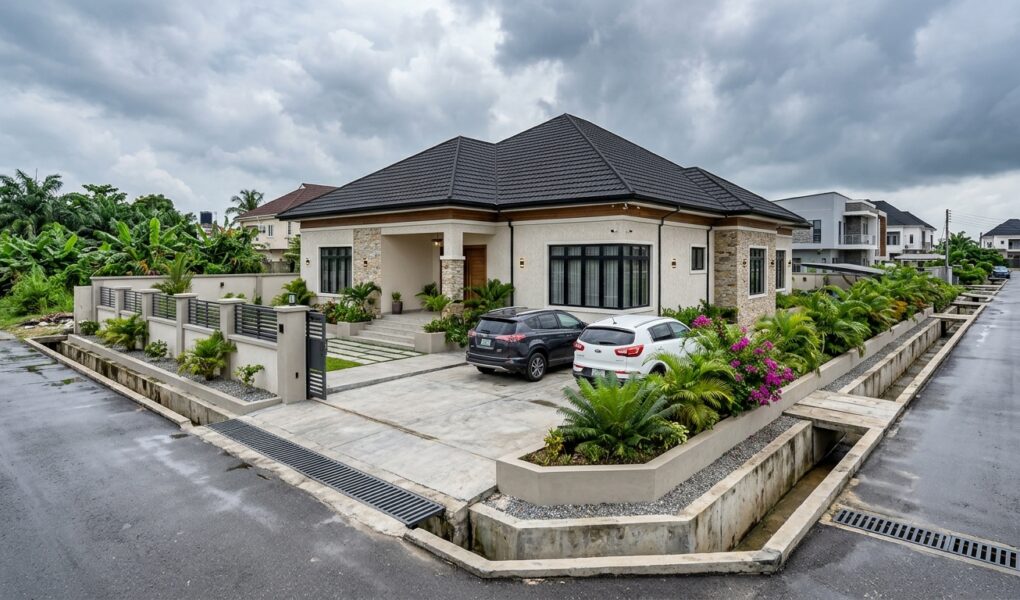
- Drainage channels around buildings.
- Suitable land grading.
- Approved connections to public drainage systems.
- Safe discharge points.
- Regular drainage maintenance arrangements.
Avoid directing water towards neighbouring properties or public roads in ways that create additional flooding problems.
A drainage system should be designed by qualified professionals and coordinated with the wider drainage network.
6. Avoid Building on Natural Waterways and Drainage Paths
Some developers make the mistake of constructing buildings on land that naturally serves as a pathway for rainwater.
This may happen when a drainage channel is filled, a natural watercourse is obstructed, or a low-lying section of land is treated as ordinary building space.
Such decisions can create serious problems.
Water will continue seeking a natural path, even when buildings, fences, or other structures obstruct its movement.
When this happens, neighbouring properties may become flooded, roads may be damaged, and water may accumulate around residential buildings.
Before purchasing or developing land, investigate whether it forms part of a natural drainage route, floodplain, wetland, or protected watercourse.
Consult the relevant planning and environmental authorities before proceeding.
A beautiful building is not worth the long-term risks associated with obstructing natural water movement.
7. Choose Construction Materials That Can Withstand Moisture Exposure
Where flood exposure cannot be completely eliminated, material selection becomes particularly important.
Some building materials deteriorate quickly when repeatedly exposed to moisture.
For example, certain wooden fittings may swell or rot, some paints may peel, and poorly protected metal components may corrode.
Developers should discuss moisture-resistant construction materials and appropriate protective treatments with their architects and engineers.
Consider:
- Suitable floor and wall finishes.
- Proper waterproofing systems.
- Moisture-resistant doors and fittings.
- Corrosion-resistant metal components.
- Appropriate external wall treatments.
- Durable electrical installation materials.
- Water-resistant insulation where appropriate.
It is also important to ensure that electrical installations, sockets, distribution boards, and other sensitive components are positioned and protected according to professional safety requirements.
The objective is to reduce damage if water enters the property, not to use materials as a substitute for proper flood-risk management.
8. Investigate the History of Nearby Roads and Neighbourhoods
Flooding does not always begin inside the property boundary.
Sometimes, the biggest challenge comes from surrounding roads, neighbouring developments, and public drainage infrastructure.
A house may be constructed on relatively elevated land but become difficult to access when nearby roads are submerged.
This can affect residents, visitors, emergency services, and property maintenance activities.
Before developing residential property, investigate whether:
- Access roads become flooded during heavy rainfall.
- Nearby streets experience prolonged waterlogging.
- Drainage channels frequently overflow.
- Neighbouring developments obstruct water movement.
- Floodwater affects entrances and surrounding walkways.
- Emergency vehicles can reach the property during severe rainfall.
A property should not be evaluated in isolation.
The condition of its surrounding environment is an important part of its long-term residential suitability.
9. Consider the Financial Implications of Flood Damage
Flooding can create significant financial pressure for homeowners, landlords, and property developers.
Even when a building remains structurally sound, floodwater can damage flooring, furniture, electrical appliances, doors, household equipment, and other valuable belongings.
Repeated flooding may also increase maintenance and repair expenses.
Property owners may need to spend money on:
- Water removal and cleaning.
- Structural inspections.
- Electrical repairs.
- Replacement of damaged fittings.
- Wall treatment and repainting.
- Drainage improvements.
- Landscaping restoration.
- Repairs to access roads and external structures.
For landlords, repeated flooding can also lead to tenant complaints, temporary vacancies, rental disputes, and reduced rental demand.
When calculating the financial viability of a residential development, include potential flood-related expenses in your risk assessment.
A property that appears affordable at the purchase stage may become expensive to maintain over time.
10. Understand How Flood History Can Affect Property Value
Flood history can influence the marketability and value of residential property.
Buyers generally prefer properties located in areas where flooding is uncommon and drainage infrastructure is reliable.
A property with a documented history of repeated flooding may attract fewer buyers, particularly when previous incidents have caused significant damage.
Some prospective homeowners may demand lower prices to compensate for perceived environmental risks and future maintenance costs.
Similarly, landlords may find it more difficult to attract tenants who are concerned about flooding.
However, the impact on property value depends on several factors, including:
- The severity and frequency of previous flooding.
- The effectiveness of subsequent mitigation measures.
- The property’s elevation.
- Building quality.
- Access road conditions.
- Neighbourhood infrastructure.
- Local property demand.
A location with a history of flooding may become more suitable for development if effective flood-control infrastructure is introduced and its performance is demonstrated over time.
Nevertheless, buyers should verify the improvements rather than relying on promises.
11. Consider the Effect on Insurance and Risk Management
Property insurance is another important consideration for developers operating in flood-prone locations.
Flood-related damage may not be covered under every standard property insurance policy.
Before developing or purchasing a residential property, speak with reputable insurance providers about available coverage.
Ask specifically about:
- Flood damage protection.
- Structural damage.
- Damage to electrical installations.
- Contents and household belongings.
- Exclusions and policy limitations.
- Deductibles and claim requirements.
Do not assume that ordinary building insurance automatically covers flooding.
Understand the exact terms of the policy and disclose relevant property information accurately.
Insurance should complement proper flood prevention and mitigation measures rather than replace them.
12. Pay Attention to Seasonal Changes
One mistake prospective property buyers make is visiting land only during the dry season.
A location that appears attractive in January or February may have completely different environmental conditions during the peak rainy season.
Before making a final decision, try to understand how the neighbourhood behaves throughout the year.
Ask residents questions such as:
- Does water enter homes during heavy rainfall?
- How long does flooding usually last?
- Are roads accessible during the rainy season?
- Does water accumulate around building foundations?
- Have drainage improvements reduced previous problems?
- Are there particular months when flooding becomes more severe?
Where possible, inspect the property during or shortly after substantial rainfall.
A seasonal assessment can reveal drainage problems that may not be obvious during dry weather.
13. Evaluate Whether Flood Mitigation Is Economically Practical
Not every flood-prone property is automatically unsuitable for development.
Some locations may have manageable drainage challenges, while others may require extensive engineering interventions.
The important question is whether the risks can be reduced to an acceptable level at a financially reasonable cost.
Before purchasing land, obtain professional advice on the cost of the necessary mitigation measures.
Compare these costs with the property’s purchase price, expected development expenses, potential rental income, and long-term maintenance requirements.
If the proposed development requires expensive drainage infrastructure, substantial ground improvement, or complex structural protection, the financial benefits may no longer justify the investment.
In some situations, walking away from a property is the most financially responsible decision.
14. Check Planning Regulations and Environmental Requirements
Residential development in Nigeria must comply with applicable planning, environmental, and building regulations.
Flood-prone locations may have additional restrictions relating to setbacks, drainage reserves, wetlands, waterways, and floodplains.
Before construction, investigate the applicable requirements through the relevant state or local planning authorities.
In Lagos, for example, developers should seek guidance from the relevant planning and environmental agencies before undertaking projects in locations with potential flood risks.
Do not assume that having a registered survey plan or a valid land title automatically means a property is environmentally suitable for residential construction.
Land ownership and development suitability are two different issues.
15. Think About Future Climate and Urban Development Risks
Flood risk is not necessarily fixed.
Changes in rainfall patterns, urban expansion, land use, vegetation cover, and drainage infrastructure can influence how a neighbourhood responds to heavy rainfall.
For example, when undeveloped land is replaced with roads, concrete surfaces, and buildings, less rainwater may soak naturally into the ground.
This can increase surface runoff and place additional pressure on drainage systems.
A residential property that has experienced little flooding in the past may face greater exposure if surrounding development is poorly managed.
Developers should therefore consider long-term environmental conditions rather than relying exclusively on historical observations.
Where possible, consult current flood-risk information and professional assessments that account for future development and climate-related risks.
Common Mistakes to Avoid When Developing Property in Flood-Prone Areas
Before commencing a residential development project, avoid these mistakes:
- Ignoring local flood history: Previous flooding incidents provide important information about the suitability of a location.
- Buying land based on appearance: Dry land during the dry season does not guarantee year-round safety.
- Ignoring natural drainage paths: Blocking waterways can worsen flooding for your property and surrounding communities.
- Relying entirely on raised foundations: Elevating a building does not eliminate every form of flood risk.
- Using inadequate drainage systems: Poor drainage planning can expose buildings to repeated water accumulation.
- Ignoring neighbouring roads: A property can remain inaccessible even when the building itself is protected.
- Underestimating maintenance expenses: Repeated exposure to moisture can increase repair and replacement costs.
- Failing to consult professionals: Flood-risk assessment, soil investigation, structural design, and drainage planning require qualified expertise.
- Assuming insurance covers everything: Some insurance policies exclude flood-related losses.
- Ignoring future environmental changes: Urban expansion and changing rainfall patterns can alter flood exposure over time.
Final Thoughts
Flood history should be one of the major considerations when purchasing land or developing residential property in Nigeria.
A property may have an attractive location, affordable land price, and impressive development potential, but these advantages can quickly lose their appeal if the neighbourhood experiences repeated flooding.
For homeowners, understanding flood history helps protect families, belongings, and long-term investments.
For property developers, it supports better site selection, safer building designs, more effective drainage systems, and more realistic project budgets.
The most important lesson is simple: do not evaluate residential land based only on what you see today. Investigate what has happened there in previous rainy seasons and what could happen in the future.
A good residential development should not only look beautiful when completed; it should also remain safe, accessible, and functional when the rains arrive.