One of the biggest secrets to successful real estate investment is not simply buying a good property. It is buying property in a good location before everyone else realizes how valuable that location could become.
A house may be beautifully built, but if demand in the area remains weak, its value may grow slowly. On the other hand, an ordinary-looking property in a rapidly developing neighborhood can become significantly more valuable as roads improve, businesses arrive, population increases and new infrastructure is developed.
This raises an important question for property investors:
How do you identify high-growth areas before property prices become too expensive?
The answer is not simply listening to an agent who says, “This place will soon become the next big area.”
Successful property investors look for evidence.
They study population growth, infrastructure, accessibility, employment, businesses, land availability, rental demand and government development plans.
Here is how to identify areas with strong potential for property growth.
1. Look for Areas Experiencing Population Growth
Population is one of the strongest drivers of housing demand.
When more people move into an area because of jobs, education, business opportunities or improved infrastructure, demand for housing can increase.
More people generally means more demand for:
- Houses
- Apartments
- Rental properties
- Shops
- Offices
- Warehouses
- Student accommodation
Before investing, ask:
Are more people moving into this area, or are people leaving?
A growing population can create opportunities for property investors, although population growth alone does not guarantee property appreciation.
2. Watch Where New Roads Are Being Developed
Infrastructure can transform a location.
A neighborhood that was previously difficult to access can become more attractive after the construction or improvement of a major road.
Better roads can reduce travel time and make previously overlooked areas more accessible to established business districts and urban centers.
Look for evidence of:
- Road construction
- Road expansion
- Bridges
- New transport routes
- Improved drainage
- Public transportation infrastructure
But be careful with rumors.
Don’t buy land simply because an agent says:
“Government will construct a major road here soon.”
Try to verify major development claims through reliable sources.
3. Pay Attention to New Businesses
Businesses follow customers—and people often follow employment opportunities.
When you begin seeing supermarkets, schools, hospitals, banks, restaurants, offices, shopping centers and other businesses entering an area, it can be a sign that economic activity is increasing.
One business opening may mean very little.
But a pattern of new development can be worth investigating.
Ask:
Why are businesses choosing this particular location?
If several independent businesses are investing in an area, they may be responding to increasing population, purchasing power or accessibility.
4. Look for Employment Centers
People want to live reasonably close to where they work.
Therefore, areas near major employment centers can have strong housing demand.
Consider locations close to:
- Industrial estates
- Technology hubs
- Universities
- Hospitals
- Government institutions
- Commercial districts
- Airports
- Large corporate offices
- Manufacturing facilities
A new employment center can potentially create demand for nearby housing.
However, don’t assume that every announced project will automatically succeed. Verify whether the development is actually progressing.
5. Study Rental Demand
If you’re buying property as an investment, don’t focus only on how much the property might be worth in ten years.
Consider what happens between now and then.
Can you rent the property?
Who are your potential tenants?
For example, an area near a university may have strong demand for student accommodation.
An area near a commercial district may attract working professionals.
A location near an industrial area may have demand from employees and businesses.
Before buying, investigate actual rental demand.
Talk to local agents, landlords and residents.
Ask:
- How quickly do houses get rented?
- What type of property is most demanded?
- What is the typical rent?
- Are there many vacant properties?
- Who are the main tenants?
6. Compare Property Prices With Nearby Areas
One useful way to identify potentially undervalued areas is to compare them with nearby established neighborhoods.
Suppose Area A is already highly developed and land costs ₦20 million per plot.
Area B is nearby, has improving roads, growing businesses and increasing residential development, but similar land costs only ₦7 million.
That difference doesn’t automatically mean Area B is a bargain.
There may be important reasons for the price difference.
But it gives you a reason to investigate further.
Look for areas where fundamentals are improving faster than prices.
7. Study Government Development Plans
Government infrastructure can have a major influence on real estate.
Look for verified information about:
- New roads
- Transportation projects
- Industrial zones
- New schools
- Hospitals
- Housing schemes
- Urban expansion
- Airports
- Special economic zones
- Other major infrastructure projects
But don’t confuse an announcement with a completed project.
A project that has been officially announced but has no funding, implementation or clear timeline may not produce the expected benefit anytime soon.
Verify before you invest.
8. Check Accessibility to Major Areas
A high-growth location does not necessarily need to be in the city center.
Sometimes the opportunity lies on the outskirts of a growing city.
What matters is accessibility.
Ask:
How long does it take to reach important destinations from this location?
Consider proximity to:
- City centers
- Major roads
- Business districts
- Schools
- Hospitals
- Markets
- Transportation hubs
- Employment centers
An area that becomes increasingly connected to the rest of the city can become more attractive to residents and investors.
9. Look at Land Availability
Areas with large amounts of undeveloped land can have significant development potential.
But there is an important distinction.
Available land does not automatically mean valuable land.
You need to determine why the land is still undeveloped.
Possible reasons could include:
- Poor accessibility
- Weak demand
- Flood risk
- Ownership problems
- Planning restrictions
- Lack of infrastructure
- Distance from economic activity
Therefore, don’t buy simply because someone says:
“There is still plenty of land here.”
Investigate what is driving the current land prices.
10. Follow the Direction of City Expansion
Cities don’t grow randomly.
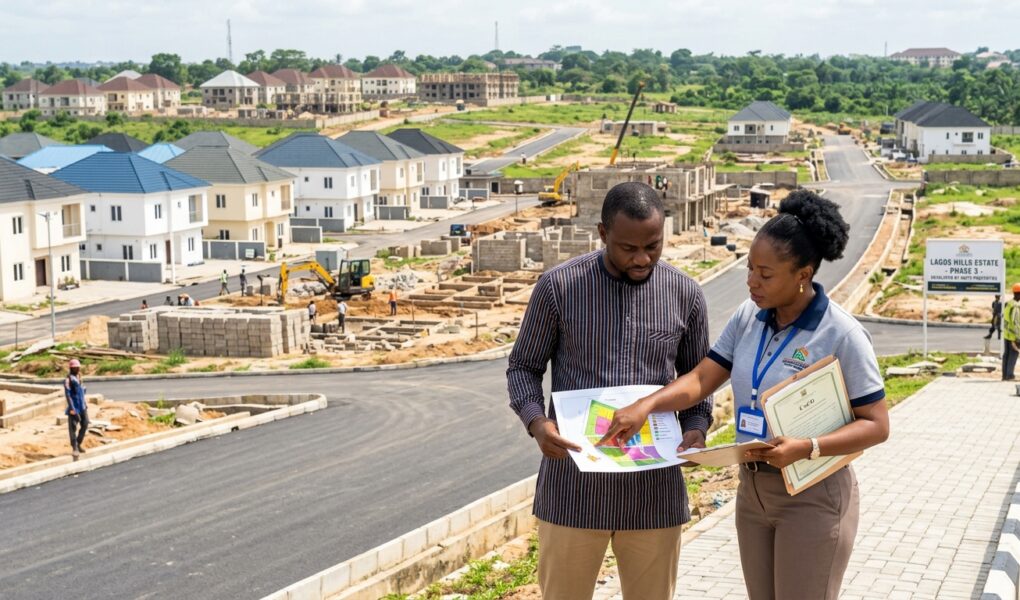
Urban development often expands outward from established centers along major roads and transportation corridors.
Look at where:
- New estates are being developed
- Businesses are expanding
- Roads are improving
- Population is increasing
- Commercial activity is moving
These patterns can help you understand the direction in which a city is expanding.
The goal is not necessarily to buy at the absolute edge of nowhere.
Instead, look for locations where today’s outskirts could become tomorrow’s established neighborhoods.
11. Check the Quality of Infrastructure
A high-growth area needs more than cheap land.
Look at:
- Roads
- Electricity
- Water
- Drainage
- Telecommunications
- Waste management
- Security
- Public transportation
Infrastructure makes an area more livable.
And livability influences housing demand.
A location with excellent development potential but extremely poor access to basic infrastructure may take much longer to mature than an investor expects.
12. Watch for New Residential Developments
Pay attention to what developers are doing.
If several established developers are acquiring land and constructing estates in the same general area, investigate why.
They may have identified:
- Population growth
- Housing shortages
- Improved infrastructure
- Rising rental demand
- Future commercial activity
However, don’t assume that a new estate automatically means the entire surrounding area will boom.
Research the actual demand.
13. Look at the Price-to-Rent Relationship
A property can be expensive without being a good investment.
Compare the purchase price with realistic rental income.
For example, if a property costs ₦50 million but generates only ₦1 million in annual rent, you should investigate whether the price makes sense for your investment objectives.
On the other hand, a less expensive property with strong rental demand may produce a different investment profile.
Rental yield is only one metric, but it can help you compare opportunities.
14. Talk to People Who Actually Live There
Online research is useful, but local residents can tell you things that property advertisements won’t.
Speak to:
- Residents
- Shop owners
- Landlords
- Security personnel
- Local business owners
- Property managers
- Experienced local agents
Ask practical questions.
What was this area like five years ago?
What has changed recently?
Are more people moving here?
What happens during heavy rainfall?
How is electricity?
Are houses easy to rent?
The answers can reveal a lot about the direction of the neighborhood.
15. Don’t Ignore Flooding and Environmental Problems
Some areas look attractive because land is cheap.
But cheap land may come with expensive problems.
Investigate:
- Flood history
- Drainage
- Soil conditions
- Erosion
- Waste disposal
- Waterlogging
- Environmental restrictions
A location cannot be considered high-growth simply because developers are building there.
The underlying land must also be suitable.
16. Verify Property Titles Before Buying
A rapidly developing area can attract both legitimate investors and fraudsters.
When property prices begin rising, land disputes and fraudulent sales can become particularly costly.
Before purchasing, conduct appropriate legal and title searches.
Confirm:
- Ownership
- Survey details
- Existing interests
- Restrictions
- Acquisition status
- Previous transactions
Use qualified professionals rather than relying solely on the seller’s explanation.
A cheap plot with a bad title is not an investment opportunity.
17. Don’t Buy Based on Rumours
This is one of the biggest mistakes new investors make.
Someone says:
“A university is coming.”
Another says:
“An airport will be built here.”
Someone else claims:
“The government will construct a major expressway.”
These stories can push land prices upward even before anything actually happens.
Before investing because of a future project, ask:
Who announced it?
Is there an official source?
Has funding been provided?
Has construction started?
What is the actual implementation status?
The more money you’re investing, the more important verification becomes.
A Simple High-Growth Area Checklist
Before buying property in an emerging location, score the area against these factors:
| Factor | What to Look For |
|---|---|
| Population | More people moving into the area |
| Roads | New or improved roads |
| Employment | New businesses and job centers |
| Infrastructure | Better electricity, water and drainage |
| Accessibility | Easier connection to major areas |
| Rental demand | Properties getting occupied quickly |
| Development | New estates and commercial projects |
| Land prices | Reasonable relative to nearby areas |
| Government projects | Verified infrastructure plans |
| Security | Improving or stable environment |
| Environment | Low flood and environmental risk |
| Documentation | Clear and verifiable property titles |
The more positive signals you find, the more reason you have to investigate the area further.
But remember: there is no checklist that guarantees property appreciation.
Don’t Try to Predict the Future Perfectly
Real estate investment involves uncertainty.
You cannot know with certainty what an area will look like ten years from now.
A planned road may be delayed.
A proposed business district may not develop as expected.
Economic conditions may change.
Interest rates, government policies and population patterns can also affect property markets.
Your goal is therefore not to predict the future perfectly.
Your goal is to make an informed decision based on the strongest evidence available today.
Final Thoughts
The best time to discover a high-growth property location is often before prices fully reflect the area’s potential.
But finding such a location requires more than listening to property agents or buying because land is cheap.
Study the population.
Follow infrastructure.
Watch where businesses are going.
Understand rental demand.
Track city expansion.
Investigate government projects.
Talk to residents.
Verify property documents.
And always investigate the reason behind the price.
Most importantly, remember this:
Don’t buy property because someone tells you an area will become valuable. Buy only after you understand why the area could become valuable—and have independently verified the evidence.
In real estate, the biggest opportunity may not always be where prices are already high.
Sometimes, it is where development is moving next.