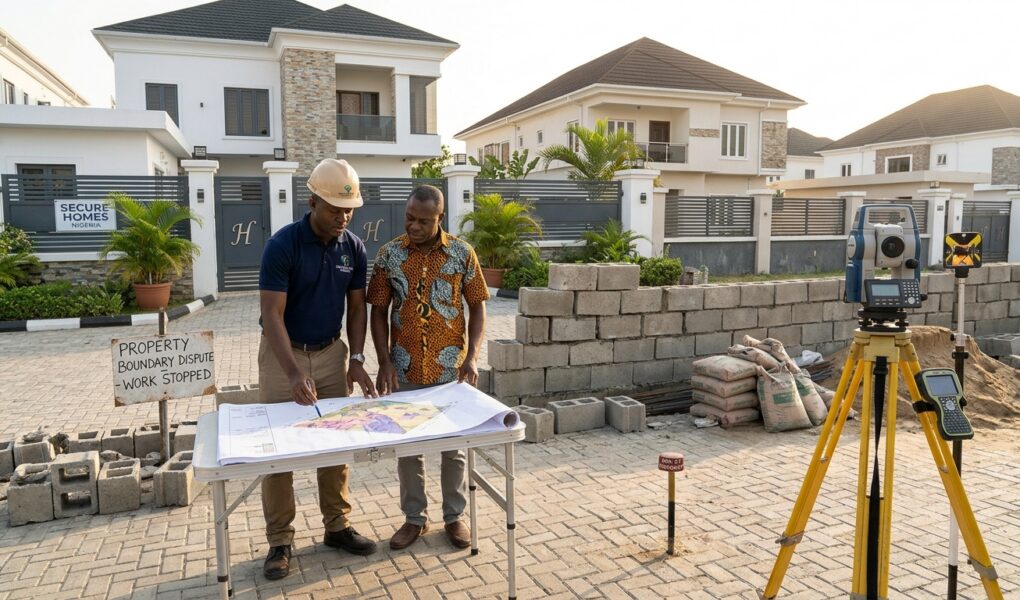
Discovering that your neighbour is building beyond their property boundary can be frustrating, especially when you have invested your savings in buying land or constructing a house. A wall may suddenly appear inside your compound, a foundation may extend into your plot, or a neighbour may begin constructing a building that seems to occupy part of your land.
In Nigeria, property boundary disputes can become complicated when ownership documents are unclear, survey plans differ, or construction continues before the parties agree on the correct boundary.
However, discovering a possible encroachment does not mean you should immediately confront your neighbour, demolish the structure, or take matters into your own hands.
The most effective approach is to establish the actual boundary, preserve evidence, communicate carefully, and seek appropriate legal assistance if necessary.
If your neighbour appears to be building on your land, here are the practical steps you should take to protect your property.
1. Do Not Assume That the Building Has Crossed Your Boundary
The first thing to do is confirm whether your neighbour has actually crossed the boundary.
A building may appear to extend into your property because an existing fence is incorrectly positioned, the original boundary markers have been moved, or the two parties are relying on different survey information.
In some cases, the problem may result from a genuine surveying mistake rather than deliberate encroachment.
Before making accusations, examine the documents relating to your property. These may include your registered survey plan, deed of assignment, Certificate of Occupancy, purchase agreement, and other relevant ownership records.
Pay particular attention to the survey plan, which should provide information about the property’s location, dimensions, and boundaries.
However, simply comparing the measurements on two documents may not be sufficient to resolve a dispute. The documents may require professional interpretation, and their legal significance depends on the circumstances.
The important first step is to verify the boundary rather than rely entirely on what you can see from the ground.
2. Hire a Qualified Land Surveyor to Identify the Boundary
If you suspect that your neighbour’s construction has crossed into your land, engage a qualified surveyor to inspect the property.
A professional surveyor can examine the relevant survey documents, identify the property’s location, and determine whether the construction appears to extend beyond the correct boundary.
Where appropriate, the surveyor may carry out a site survey, identify existing boundary beacons, and compare the physical features on the ground with the relevant survey information.
This is particularly important if the original boundary markers are missing, damaged, or appear to have been moved.
Ask the surveyor to explain the findings clearly and provide suitable documentation of the inspection.
If the neighbour disputes the results, a further survey or an agreed joint inspection may help clarify the disagreement.
Do not move boundary beacons or install new markers yourself without appropriate professional guidance and any required authorisation.
A properly documented survey can provide a stronger basis for resolving the dispute than a verbal disagreement between neighbours.
3. Gather and Organise Your Property Documents
While arranging a survey, gather the documents that may help establish your rights over the land.
Depending on the property, these may include:
- Your deed of assignment or other relevant title documents.
- Your registered survey plan.
- Your Certificate of Occupancy, where applicable.
- The purchase agreement and receipts.
- Documents relating to the seller’s ownership.
- Previous survey reports or boundary descriptions.
- Photographs showing the property before construction began.
- Relevant correspondence with the neighbour, seller, or developer.
Keep the original documents secure and make copies for your lawyer and surveyor.
If you bought the land through a real estate company, retain the allocation letter and any documents describing the plot’s dimensions and location.
If the property was inherited, obtain the relevant inheritance or estate documents where applicable.
Remember that possessing a particular document does not automatically settle every ownership dispute. The authenticity, registration status, history, and legal effect of the documents may all matter.
Organising your records early will help your legal adviser assess the situation more effectively.
4. Document the Construction Before It Progresses Further
If your neighbour is still building, preserve evidence of what is happening.
Take clear photographs and videos from a safe and lawful position. Capture the visible structure, its relationship to your property, the surrounding boundary, and any relevant construction activity.
Record the dates when you first noticed the work and when significant changes occurred.
If your surveyor identifies a possible encroachment, ask for appropriate documentation of the findings and the location of the affected area.
Keep copies of messages, letters, and other communications relating to the dispute.
If workers or contractors make statements about the construction, record relevant information accurately without trespassing, provoking confrontation, or interfering with their work.
Do not alter the site, destroy construction materials, or move boundary markers to create evidence.
Good documentation can help your lawyer assess the dispute and may become important if formal proceedings are necessary.
5. Speak to Your Neighbour Calmly and Professionally
Once you have reasonable grounds to suspect encroachment, consider approaching your neighbour to discuss the issue.
Sometimes, the neighbour may not know that the construction extends beyond the intended boundary. The problem could have resulted from incorrect measurements, incomplete information, or a misunderstanding between the parties.
Explain your concern clearly and avoid making threats or accusations that you cannot yet substantiate.
For example, you could say:
“I have noticed that the new construction appears to extend beyond the boundary of your plot. I would like us to verify the boundary using the relevant survey documents so that we can resolve the matter before construction progresses further.”
Where possible, communicate in writing so that there is a record of the discussion.
If the neighbour is willing, you may agree to have both parties’ surveyors examine the boundary or arrange a joint site inspection.
However, do not rely solely on verbal promises if construction continues or the dispute becomes serious.
If your neighbour is aggressive, refuses to discuss the matter, or threatens you, avoid confrontation and seek professional assistance.
6. Ask Your Neighbour to Pause Work on the Disputed Area
If construction is actively taking place and the suspected encroachment could become more difficult to resolve as the building progresses, it may be appropriate to request that work on the disputed portion be paused while the boundary is verified.
Explain that the purpose is to avoid unnecessary losses for both parties while the facts are established.
Make the request in writing and retain a copy.
However, understand that a request to stop construction is not the same as a legally enforceable stop-work order. If your neighbour refuses, you may need to consult a property lawyer about the appropriate legal steps.
Depending on the circumstances, a lawyer may advise whether an urgent court application or another lawful process is appropriate.
Do not assume that you can force workers to stop, block the entrance, seize equipment, or demolish part of the building yourself.
The aim is to prevent the dispute from becoming more expensive while protecting your legal position.
7. Consult a Nigerian Property Lawyer if the Dispute Continues
If your neighbour denies the encroachment, refuses to cooperate, or continues building despite credible evidence of a boundary problem, consult a qualified Nigerian property lawyer.
Take your ownership documents, survey reports, photographs, and records of your communications to the consultation.
Your lawyer can assess the nature of the dispute, the strength of the available evidence, and the legal remedies that may be available.
Depending on the facts and applicable law, possible steps may include a formal letter demanding that the encroachment stop, negotiations through legal representatives, mediation, or court proceedings.
In some cases, a property owner may seek a declaration of their rights, an injunction, recovery of possession, or other appropriate relief.
The available remedies depend on the circumstances, the evidence, and the relevant law.
If construction is ongoing, explain this to your lawyer promptly because timing may affect the practical options available.
Do not wait until the building is completed before seeking advice if there is credible evidence that your land is being occupied without your consent.
8. Consider Mediation Before the Dispute Escalates
Not every boundary dispute needs to end in a lengthy court case.
If both parties are willing to cooperate, mediation may provide a practical way to resolve the disagreement.
A neutral mediator can help the parties discuss the survey findings, identify the area in dispute, and consider possible solutions.
Depending on the facts, the parties may agree on a corrected boundary, the removal of an encroaching structure, compensation where legally appropriate, or another lawful settlement.
Any proposed agreement should be reviewed carefully before signing.
For a significant property dispute, consult your lawyer about documenting the settlement properly and determining whether further legal steps are necessary to make the agreement effective.
Do not sign a document giving away part of your land merely to end an uncomfortable disagreement.
Mediation is most useful when the parties understand the evidence and are willing to pursue a fair, lawful resolution.
9. Understand the Risks of Demolishing the Structure Yourself
One of the biggest mistakes a property owner can make is attempting to remove an allegedly encroaching wall or building without following the appropriate legal process.
Even if you believe the neighbour has clearly crossed the boundary, taking matters into your own hands can expose you to additional disputes, financial claims, or other legal consequences.
The neighbour may challenge your interpretation of the boundary, dispute your ownership documents, or allege that you damaged property unlawfully.
Instead, preserve the evidence, obtain a professional survey, and consult a lawyer about the appropriate remedy.
If a court order or other lawful process is required, follow the procedure advised by your lawyer.
Avoid threats, physical confrontations, unauthorised demolition, and damage to construction equipment or materials.
Protecting your property also means protecting yourself from actions that could weaken your legal position.
10. What If Your Neighbour Has Already Completed the Building?
A boundary dispute can become more complicated when the structure has already been completed.
The cost of resolving the matter may be higher, and the parties may have stronger disagreements about what should happen next.
However, the completion of a building does not automatically establish that the neighbour has the legal right to occupy land belonging to someone else.
The appropriate next step is to establish the boundary, review the relevant documents, and obtain legal advice.
Depending on the circumstances, your lawyer may assess whether you can pursue an injunction, recovery of possession, removal of an encroaching structure through lawful proceedings, compensation, or another appropriate remedy.
The fact that construction has been completed may affect the practical and legal considerations, but it should not discourage you from obtaining advice.
Do not assume that the only solution is to accept the encroachment or that demolition is automatically available.
The correct remedy depends on the evidence, applicable law, and specific circumstances of the case.
11. What If the Existing Fence Is in the Wrong Place?
Sometimes, the real problem is not the new building but an old fence that does not accurately follow the legal boundary.
A fence may have been installed based on informal measurements, an earlier owner’s understanding, or incorrect information supplied during construction.
If the survey indicates that the existing fence is misplaced, do not immediately remove it.
Ask the surveyor to explain the discrepancy and consult your lawyer about the implications.
The position of a fence alone may not conclusively establish the legal boundary.
If the fence needs to be moved, determine the appropriate process and whether agreement, formal notice, or other legal steps are necessary.
This is especially important where the neighbour has built permanent structures based on the same disputed boundary.
Correcting the problem carefully can prevent a minor surveying disagreement from becoming a much larger property dispute.
12. What If Both Neighbours Have Different Survey Plans?
It is possible for adjoining property owners to possess survey plans that appear inconsistent.
The reason may involve overlapping survey information, incorrect measurements, missing boundary markers, changes in the physical landscape, or uncertainty about the original allocation of the plots.
Do not automatically assume that the newer survey plan is correct or that the document with the largest number of official-looking stamps must prevail.
Have a qualified surveyor examine the relevant documents and investigate the source of the discrepancy.
Where necessary, seek clarification from the appropriate land administration authority.
Your lawyer can assess how the documents relate to the parties’ ownership claims and what further evidence may be needed.
If the disagreement cannot be resolved through professional examination and negotiation, formal legal proceedings may be necessary.
The important thing is to establish the facts before agreeing to move a boundary or surrender any part of the property.
13. How to Prevent Boundary Disputes When Buying Land
Although some disputes cannot be predicted, buyers can reduce their risk by carrying out proper checks before purchasing land.
Before paying for a property, take the following precautions:
- Engage a qualified surveyor to identify the land and verify its dimensions.
- Confirm the relevant boundaries and inspect the physical site.
- Investigate the seller’s ownership and the property’s title documents.
- Check for overlapping claims, disputes, or conflicting survey information.
- Avoid relying entirely on verbal descriptions of the plot.
- Obtain a written agreement that accurately identifies the property.
- Ensure that allocation documents correspond with the actual plot.
- Retain copies of all relevant records and receipts.
If the land is part of a larger estate or development, verify that the plot allocated to you matches the documents supplied by the developer.
Do not assume that a fence, wall, or physical marker automatically proves ownership.
A careful inspection before purchase can help you avoid costly disagreements later.
Common Mistakes to Avoid During a Boundary Dispute
When a neighbour appears to be building on your land, avoid these common mistakes:
- Accusing the neighbour before verifying the boundary.
- Relying only on an old fence or informal measurements.
- Ignoring differences between survey plans.
- Allowing construction to progress without seeking advice.
- Threatening workers or physically confronting the neighbour.
- Demolishing a wall or damaging construction materials yourself.
- Signing an agreement without understanding its consequences.
- Failing to preserve photographs and relevant documents.
- Waiting too long before consulting a property lawyer.
- Assuming that completing a building automatically settles the ownership dispute.
A careful, evidence-based approach can help you protect your property without unnecessarily escalating the disagreement.
Final Thoughts
Discovering that your neighbour may have built beyond their property boundary can be stressful, particularly when the disputed area represents a significant part of your land or investment.
However, the best response is not to act out of anger or rely entirely on assumptions.
Start by examining your property documents and engaging a qualified surveyor to establish the actual boundary. Document the construction, communicate with your neighbour where safe and appropriate, and seek legal advice if the disagreement continues.
If the situation requires urgent action, ask your lawyer about the lawful options available rather than attempting to stop construction or remove a structure yourself.
Most importantly, do not ignore credible signs of encroachment. Addressing the issue early may prevent further construction, reduce the cost of resolving the dispute, and help protect your ownership rights.
Your property boundary should be established by reliable evidence and applicable law, not by guesswork or confrontation.
Frequently Asked Questions
Can my neighbour build a wall on my land in Nigeria?
A neighbour’s right to build depends on the actual property boundary, their ownership or other lawful rights, and applicable regulations. If you suspect encroachment, obtain a professional survey and seek legal advice.
How can I prove that my neighbour has encroached on my land?
Relevant evidence may include your ownership documents, survey plans, a professional boundary survey, dated photographs, and other records showing the location and extent of the alleged encroachment.
Can I demolish my neighbour’s wall if it crosses my boundary?
Do not demolish it yourself. Consult a qualified property lawyer about the lawful process for resolving the encroachment and obtaining any necessary court order or other authorisation.
What should I do if my neighbour refuses to stop construction?
Preserve the evidence and consult a property lawyer promptly. Your lawyer can assess whether a formal demand, mediation, an urgent court application, or another legal remedy is appropriate.
Can two survey plans show conflicting boundaries?
Yes. Conflicting plans or measurements can arise for several reasons. A qualified surveyor should investigate the discrepancy, and a property lawyer can advise on its legal implications.
Should I go to court immediately?
Not necessarily. Professional surveying, direct communication, and mediation may resolve some disputes. However, if construction is ongoing or your neighbour refuses to cooperate, obtain legal advice promptly about protecting your rights.