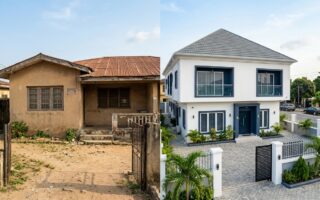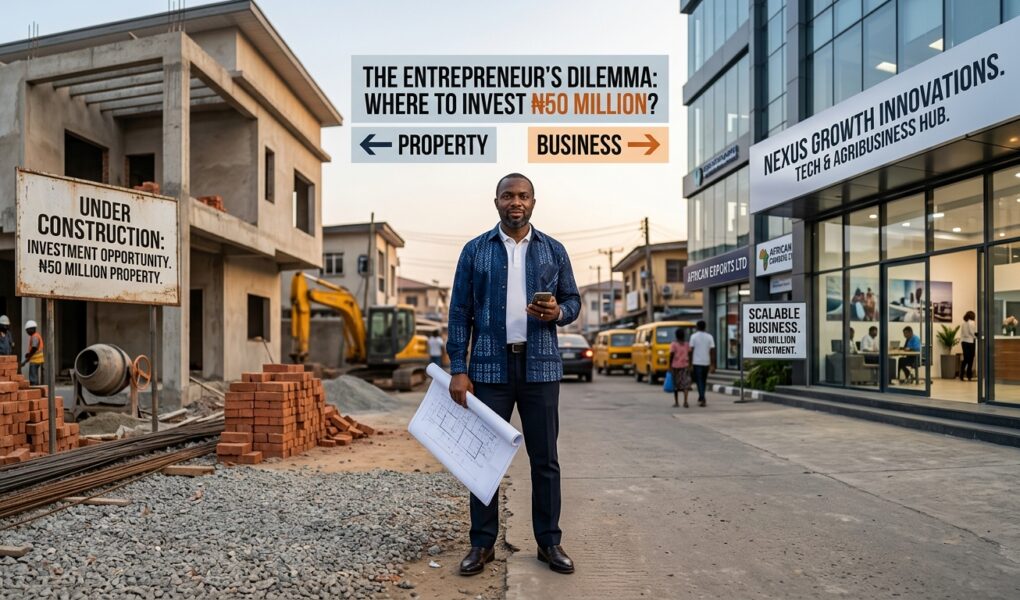
If you suddenly had ₦50 million available, what would you do with it?
Would you use the money to start or expand a business, or would you build a house?
There is no universal answer because businesses can generate substantial income, while real estate can also come with risks, costs and periods of low liquidity. However, for someone whose priority is long-term financial security, owning a home and preserving wealth, putting a significant portion of ₦50 million into a well-planned house can make a lot of sense.
A business can fail. A house, when properly located, legally documented and well maintained, can continue to provide shelter and potentially retain or increase in value over time.
@qadevaofficial Replying to @quadrihardeyanju ♬ original sound – Omario
This is particularly important in Nigeria, where housing costs and rents can place significant pressure on households.
But before you decide to put ₦50 million into a building project instead of a business, you need to understand the advantages, limitations and circumstances in which each option makes sense.
Here are some reasons why building a house could be the better choice for certain people.
1. A House Gives You Something You Can Physically Own
When you spend ₦50 million on a business, much of your money may go into inventory, equipment, marketing, salaries, rent, technology and working capital.
If the business fails, some of that money may never come back.
A properly acquired property is different.
At the end of a successful building project, you have a physical asset.
You can live in it, rent it out, sell it or potentially use it as collateral for future financing, subject to the property’s legal status and applicable lending requirements.
The building itself may also require maintenance, but it does not disappear simply because one month of business was poor.
This tangible nature of real estate is one reason some Nigerians prefer property as a wealth-preservation strategy.
2. You Eliminate or Reduce Your Own Rent Burden
If you currently pay rent, building your own house can remove a major recurring expense once the property is completed and you move in.
Consider someone spending ₦2 million every year on rent.
Over 10 years, that represents ₦20 million in rent payments, without necessarily giving the tenant ownership of the property.
If you build and own your home, the money that would have gone toward rent can potentially be redirected toward other financial goals.
However, owning a house does not mean living completely free of housing expenses.
You may still have:
- Maintenance costs
- Security expenses
- Utility bills
- Estate fees
- Property-related taxes or charges
- Repairs
- Renovation expenses
The major difference is that you are no longer paying rent to occupy someone else’s property.
3. Your House Can Become a Family Asset
A well-planned home can serve your family for decades.
You could build a property that accommodates your spouse, children and possibly future generations.
Unlike many businesses, which depend heavily on the owner, a properly documented property can remain within the family even after the person who built it is gone.
This makes property ownership attractive to people who think beyond immediate income.
You are not simply building walls and putting a roof over them.
You may be creating an asset that your children can inherit.
Of course, proper estate planning and documentation are important if you want the property to be transferred smoothly to your beneficiaries.
4. You Can Generate Rental Income From the Property
Building a house does not necessarily mean constructing a property exclusively for your own use.
With proper planning, part of the building can potentially generate rental income.
For example, depending on the location and planning regulations, a ₦50 million development could be designed to include:
- A personal residence
- Self-contained units
- Mini flats
- One-bedroom apartments
- Shops or other suitable commercial spaces
The exact design should depend on the location, demand, planning requirements and available budget.
If the property generates rent, you potentially have both an asset and an income-producing property.
That can be particularly attractive in areas with strong and sustainable rental demand.
5. You Have Greater Control Over the Asset
A business involves many variables.
Your customers can disappear.
Competitors can enter the market.
Suppliers can increase prices.
Employees can leave.
Government regulations can change.
A landlord can increase your commercial rent.
Economic conditions can reduce consumer spending.
With your own property, you have much greater control over the physical asset.
You decide how it is maintained, whether you want to renovate it, whether you want to live there or whether you want to rent it out.
That control can provide a sense of financial security.
However, real estate is not risk-free. Poor location, defective construction, disputed ownership, inadequate documentation and falling demand can negatively affect a property’s usefulness and value.
6. Land Can Appreciate Over Time
One reason Nigerians invest heavily in real estate is the possibility that land values may increase as areas develop.
A piece of land that is relatively inexpensive today may become more valuable if the surrounding area experiences:
- Better roads
- New businesses
- Improved infrastructure
- Population growth
- New schools
- Shopping centres
- Industrial development
- Improved transportation
However, appreciation is not guaranteed.
Buying property simply because someone promises that “this place will soon become the next big area” can be dangerous.
Location research and proper due diligence are essential.
The goal should be to buy property based on real fundamentals rather than speculation.
7. A House Can Protect You From Future Housing Uncertainty
Rent can become more expensive over time.
A landlord may increase the rent when your current tenancy expires, leaving you with the choice of paying more or moving.
Owning your own home gives you greater control over where you live.
You are not completely protected from rising costs because maintenance and utilities can become more expensive, but you have removed one major source of uncertainty: dependence on a landlord for continued occupancy.
For families, this stability can be particularly valuable.
8. You Can Build According to Your Actual Needs
When you buy an already completed house, you may have to compromise.
Perhaps the kitchen is too small.
Maybe there is no space for a home office.
The bedrooms may not be positioned the way you want.
There may not be enough parking space.
The compound may be too small.
Building from scratch gives you greater control over the design.
You can plan the house around your lifestyle and budget.
For example, you could prioritize:
- Adequate parking
- Good ventilation
- Efficient drainage
- Energy-saving features
- Water storage
- Security
- Future expansion
- Rental units
- Home office space
Good planning is important because a beautiful house that is too expensive to maintain can become a financial burden.
9. A Business Requires Active Management
One major difference between business and property is the amount of active involvement required.
Many businesses require constant attention.
You may need to:
- Find customers
- Manage employees
- Monitor cash flow
- Purchase inventory
- Handle suppliers
- Advertise
- Resolve complaints
- Pay taxes and expenses
- Respond to competition
If you stop paying attention to the business, performance may decline.
A rental property can also require management, especially if you have multiple tenants, but the nature of the work is different.
You can potentially hire a property manager to handle some responsibilities.
This does not mean property is completely passive. Maintenance, tenant issues, vacancies and repairs still require attention.
10. A House Can Provide Psychological Security
Financial decisions are not purely mathematical.
For many Nigerians, owning a house provides a powerful sense of achievement and security.
After years of paying rent, owning a home can provide peace of mind.
You know that your family has a place to live.
You also have an asset that can potentially remain useful regardless of whether your business succeeds or fails.
For someone who has already built a successful business, purchasing or building a home can therefore be an important way of moving some wealth from a business that depends on their active involvement into a physical asset.
11. Putting All ₦50 Million Into Business Can Be Risky
This is an important point.
If the entire ₦50 million represents your life savings, putting every naira into one business may expose you to significant concentration risk.
Suppose the business experiences serious difficulties.
You could lose your source of income and a large portion of your savings at the same time.
That is why diversification matters.
Instead of thinking:
“Business or house?”
you could also ask:
“How can I divide my money so that one bad outcome does not destroy my financial position?”
Depending on your circumstances, someone might choose to build a modest house while retaining capital for business or other investments.
The appropriate allocation depends on income, existing assets, debt, family responsibilities, business experience and risk tolerance.
12. But Don’t Build a ₦50 Million House Just to Say You Own One
There is an important warning here.
Building a house is not automatically a better financial decision.
You can make a terrible investment in real estate.
For example, spending ₦50 million on a huge house in an area with poor infrastructure, weak demand and limited resale potential may not be financially sensible.
A large building can also become expensive to maintain.
If you spend everything on a beautiful property and have no emergency fund, no income and no productive investment, you may become asset-rich but cash-poor.
That is why the goal should not simply be:
“Build a ₦50 million house.”
The better goal is:
“Use my ₦50 million in a way that improves my long-term financial security.”
13. Consider Building a Smaller House and Investing the Balance
You do not necessarily have to spend the entire ₦50 million on your house.
This could be one of the smartest approaches for someone who wants both property and investment exposure.
For example, rather than building an unnecessarily expensive house, you might construct a comfortable home for ₦30–₦35 million and retain the balance for:
- Business capital
- Emergency savings
- Education
- Retirement investments
- Income-producing assets
- Property improvements
- Other diversified investments
The actual amounts should depend on your financial situation.
The important principle is to avoid putting all your wealth into one asset simply because you can afford to.
14. A ₦50 Million Business Could Also Create More Wealth
It would be unfair to suggest that business is always inferior to property.
A successful business can potentially produce much higher returns than a residential property.
If you have a proven business model, strong management skills, reliable demand and a clear plan for deploying additional capital, investing in your business may make financial sense.
For example, an existing profitable business with strong cash flow may benefit significantly from additional capital.
The key difference is risk and certainty.
A business may generate substantial profits, but it can also lose money.
Real estate can preserve wealth and potentially appreciate, but it can also produce poor returns, remain vacant or lose value in certain circumstances.
You should evaluate both options based on your actual circumstances rather than assuming one asset class is automatically superior.
15. The Best Approach May Be to Do Both
For many people, the real answer may not be choosing between a house and a business.
It may be finding a balance.
If you already have a profitable business, you could use part of your wealth to secure your home while keeping enough capital in the business to continue generating income.
For example:
₦50 million available
→ Build a modest, quality home
→ Keep an emergency reserve
→ Maintain sufficient business working capital
→ Invest additional money gradually
This approach can give you both financial security and productive capital.
The exact allocation should be based on your circumstances rather than a fixed formula.
What Should You Do Before Spending ₦50 Million?
Before committing such a large amount of money, ask yourself these questions:
Do I already own a house?
If you already own a comfortable home, putting another large amount into residential property may not be your highest priority.
Do I have a stable source of income?
A house does not automatically generate enough cash to cover your everyday expenses.
Is my business already profitable?
If you have a proven business with strong demand, additional capital may create meaningful opportunities.
Do I have emergency savings?
Do not use every naira you have to build a house.
Unexpected expenses happen.
Where will I build?
Location can be as important as the building itself.
Have I verified the land?
Never begin construction simply because someone told you that the land is genuine.
Can I maintain the house?
Think beyond construction.
Consider security, repairs, electricity, water, cleaning, estate charges and general maintenance.
What is my long-term goal?
Are you trying to reduce rent?
Create family wealth?
Generate rental income?
Retire?
Build a business?
Your answer should influence where your money goes.
Final Thoughts
If you have ₦50 million, building a house can be a powerful way to secure a physical asset, reduce your dependence on rented accommodation and create something that can benefit your family for many years.
But that does not mean building a house is automatically better than starting or expanding a business.
A successful business can generate income and potentially grow your wealth much faster than a house.
The smarter question is not simply:
“Should I build a house or do business with ₦50 million?”
Instead, ask:
“Which decision gives me the best combination of security, income, growth and financial flexibility based on my current situation?”
For someone who has no home, has stable income and wants long-term security, building a reasonably priced house may be a sensible priority.
For someone who already owns a home and has a proven, profitable business, putting additional capital into that business may make more sense.
And for many people, the best strategy may be somewhere in between.
Don’t spend ₦50 million just because you have ₦50 million. Give every naira a purpose.
A good financial decision should leave you not only with an impressive asset, but also with enough financial strength to handle tomorrow.