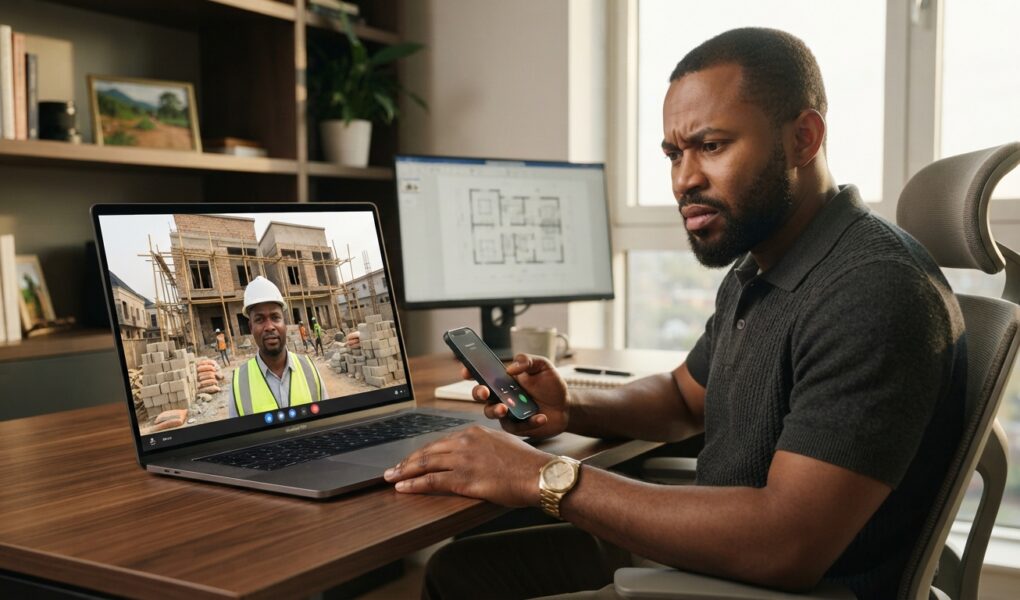
Hiring a building contractor is one of the most important decisions you will make when constructing a house. Beyond the contractor’s ability to coordinate workers, purchase materials and supervise construction activities, you also need someone who communicates regularly and keeps you informed about the progress of your investment.
This becomes particularly important when you are building a house in Nigeria while living abroad.
For Nigerians in the United Kingdom, United States, Canada, Germany and other countries, regular construction updates provide reassurance that work is progressing as planned. Photographs, videos, financial reports and regular communication help property owners understand what is happening at their construction sites without having to travel home frequently.
But what happens when your building contractor suddenly stops sending progress updates?
Perhaps the contractor used to send photographs every week but has now gone silent. Maybe your calls are no longer answered promptly, or your requests for information about construction activities receive vague responses.
Should you be worried? Does it mean something is wrong with your building project? Could your money or construction materials be at risk?
Although a communication gap does not automatically mean that your contractor is engaging in fraudulent activities, it is a situation that deserves immediate attention.
Here is what property owners should understand when a building contractor stops providing progress updates and how to protect their investments.
1. You Lose Visibility Into What Is Happening at Your Construction Site
One of the immediate consequences of a contractor stopping progress updates is losing visibility into construction activities.
When you receive regular reports, you can see which stages have been completed, what workers are currently doing and what activities are planned next.
Without these updates, you may have no reliable way of knowing whether construction is progressing, slowing down or has completely stopped.
For someone living abroad, this situation can be particularly frustrating.
You may continue receiving requests for money without knowing whether the previous funds have been properly utilised.
This is why regular communication should be treated as an essential part of construction management rather than an optional favour from the contractor.
2. You May Not Know Whether Your Money Is Being Properly Managed
Construction projects require significant financial commitments.
Property owners regularly send money for cement, reinforcement bars, sand, granite, labour, transportation and other building expenses.
When a contractor stops providing updates, it becomes more difficult to establish how these funds are being spent.
For example, you may have transferred money for roofing materials, but without invoices, delivery records or photographs, you cannot easily confirm whether the materials were purchased.
Similarly, you may have paid for a particular construction milestone without knowing whether the agreed work has actually been completed.
This creates an accountability problem.
Every payment should have a clear purpose, and contractors should be able to provide reasonable documentation explaining how project funds are being used.
If your contractor cannot account for significant amounts of money, you should investigate before approving additional payments.
3. Construction Delays May Go Unnoticed
A building project can experience delays for several reasons.
These may include shortages of materials, insufficient funds, bad weather, labour problems, transportation difficulties or unexpected construction challenges.
A responsible contractor should communicate significant delays and explain how they affect the project schedule.
However, when updates stop, you may not discover that construction has been delayed until much later.
Imagine sending money for the completion of your roof and expecting to receive photographs within a week. Several weeks pass, but the contractor provides no meaningful information.
Without proper communication, you cannot determine whether the delay is genuine, whether workers are still on site or whether another problem has developed.
Regular progress reporting helps identify delays early and allows property owners to make informed decisions.
4. Building Materials Could Become Difficult to Account For
Building materials represent a substantial portion of construction expenditure.
Cement, iron rods, roofing sheets, electrical cables, plumbing materials, tiles and other items must be properly accounted for.
When a contractor stops providing updates, you may struggle to determine:
- Which materials have been purchased.
- How much material has been delivered.
- What quantities have been used.
- What materials remain at the site.
- Whether additional purchases are genuinely necessary.
This is particularly concerning when expensive materials are stored at construction sites without adequate security.
To avoid these problems, request material inventories, purchase receipts and delivery notes.
Where possible, appoint an independent person to verify important deliveries and inspect materials stored on the property.
5. You May Miss Important Construction Defects
Not every construction problem becomes immediately visible after a building component has been completed.
Some defects occur during foundation work, reinforcement placement, concrete mixing, blockwork, roofing or plumbing installations.
If you are not receiving updates, you may miss the opportunity to ask questions or request professional inspections before subsequent work covers the affected areas.
For example, reinforcement bars may be incorrectly positioned before concrete is poured over them.
Once the concrete has hardened, identifying and correcting the problem can become more complicated and expensive.
This is why progress updates should include photographs of important construction activities before they are covered by subsequent work.
For major structural activities, independent professional inspections are more reliable than photographs alone.
6. Your Contractor May Be Experiencing Problems
It is important not to immediately assume that a contractor who stops communicating is dishonest.
There may be genuine reasons behind the communication breakdown.
For example:
- The contractor may be experiencing personal difficulties.
- Workers may have abandoned the site temporarily.
- The project may have encountered financial challenges.
- Materials may be unavailable.
- Weather conditions may have interrupted construction.
- There may be disagreements with subcontractors.
- The contractor may be managing too many projects simultaneously.
However, genuine difficulties should not become an excuse for completely abandoning communication.
A professional contractor should inform the property owner about significant challenges, explain the situation and provide a realistic plan for resolving the problem.
7. It Can Create Disagreements Between You and Your Contractor
Poor communication is one of the common causes of disputes in construction projects.
When property owners do not receive regular updates, they may begin questioning whether the contractor is fulfilling contractual obligations.
The contractor, on the other hand, may believe that the owner is being unnecessarily demanding.
Over time, this misunderstanding can damage the working relationship.
For example, you may expect a particular stage of construction to be completed within an agreed period, while the contractor may have encountered problems that were never communicated.
A properly written construction agreement should establish reporting responsibilities, payment conditions, project timelines and procedures for handling delays.
Both parties should understand their responsibilities from the beginning.
8. You May Lose Control Over Construction Decisions
Building a house involves numerous decisions.
You may need to approve changes to building materials, room dimensions, finishing designs, electrical installations, plumbing arrangements and other construction details.
When a contractor stops communicating, these decisions may be delayed or made without your knowledge.
This can become particularly problematic when the contractor begins making changes to the original architectural or structural plans.
Never assume that a contractor has unlimited authority to change important building specifications simply because you are not physically present.
Any significant changes should be discussed with you and approved by the appropriate professionals.
Structural changes should receive the necessary review and approval from the responsible engineer or architect.
Warning Signs That Your Contractor’s Silence Requires Immediate Attention
A contractor missing one scheduled update does not necessarily mean your project is in danger.
However, certain patterns should not be ignored.
Watch out for the following warning signs:
1. Repeated unanswered calls: Your contractor consistently ignores calls and messages requesting basic construction information.
2. Refusal to provide photographs: Despite repeated requests, the contractor refuses to provide recent pictures or videos of the property.
3. Unexplained requests for additional money: You continue receiving payment demands without supporting documents or explanations.
4. Conflicting information: Different people provide inconsistent accounts of what is happening at the construction site.
5. Unexplained construction stoppages: Workers are no longer attending the site, but the contractor has not provided a satisfactory explanation.
6. Missing material records: The contractor cannot account for materials previously purchased with your money.
7. Avoidance of independent inspections: The contractor discourages you from sending another professional to inspect the property.
8. Repeated broken promises: You are continuously given new dates for progress reports that never arrive.
When several of these warning signs occur together, it may be time to take stronger steps to protect your investment.
What Should You Do When Your Contractor Stops Sending Updates?
If you find yourself in this situation, avoid making emotional decisions immediately.
Instead, take the following practical steps.
1. Contact the Contractor Through Multiple Channels
Start by contacting your contractor through the communication channels you normally use.
Send a polite but direct message requesting information about the current construction status.
You can use WhatsApp, telephone calls, email or other communication channels previously agreed upon.
Ask specific questions rather than simply saying that you want an update.
For example:
- What construction activities have been completed?
- What work is currently ongoing?
- Are workers still attending the site?
- What materials have been purchased?
- Has the project experienced any delays?
- When can you expect the next progress report?
Give the contractor a reasonable deadline to respond.
2. Request Recent Photographs and Videos
Ask for dated photographs and videos showing the current condition of the property.
Request footage of the entire building rather than only the sections the contractor chooses to show you.
If possible, arrange a live video call so that you can ask questions while someone walks around the construction site.
Remember that photographs can be outdated or misleading, so independent verification may still be necessary.
3. Suspend Unverified Additional Payments
If you cannot establish what happened to previous funds, be cautious about transferring additional money.
This does not mean refusing legitimate contractual payments.
Rather, it means ensuring that payment requests are supported by evidence and comply with the payment terms in your agreement.
Where necessary, request an updated account statement showing previous payments, expenditure and outstanding obligations.
4. Appoint an Independent Professional to Inspect the Property
If communication does not improve, consider engaging an independent architect, quantity surveyor, structural engineer or construction consultant.
The professional should visit the site and provide an objective assessment of:
- Actual construction progress.
- Quality of completed work.
- Materials available at the site.
- Work remaining.
- Possible defects.
- Differences between the approved plans and actual construction.
Ask for a written inspection report with dated photographs.
This is particularly important when you are living outside Nigeria and cannot personally verify the situation.
5. Review Your Construction Agreement
Locate the agreement signed between you and the contractor.
Review the sections covering:
- Project completion dates.
- Payment schedules.
- Construction milestones.
- Reporting obligations.
- Contractor responsibilities.
- Handling of delays.
- Termination conditions.
- Dispute resolution.
If the contractor has failed to meet agreed obligations, obtain legal advice before taking steps such as terminating the contract or withholding payments.
Your rights and available remedies will depend on the contract and applicable Nigerian law.
6. Secure Your Property and Remaining Materials
If there are indications that construction has been abandoned or materials may be at risk, take steps to protect the property.
Arrange for an authorised person to inspect the site, confirm the condition of stored materials and review existing security arrangements.
Keep an inventory of valuable materials and document their condition.
If necessary, arrange additional security while the situation is being resolved.
7. Consider Replacing the Contractor if Necessary
If the contractor repeatedly refuses to communicate, cannot account for project funds or fails to fulfil contractual responsibilities, replacing them may become necessary.
However, avoid making this decision without proper documentation.
First, arrange an independent assessment of the completed work, outstanding obligations and financial position.
Consult a lawyer where contractual termination or recovery of money is involved.
A new contractor should receive a documented handover covering completed construction activities, materials, drawings, outstanding payments and identified defects.
How Nigerians in the Diaspora Can Prevent This Problem
The best way to manage communication problems is to establish clear expectations before construction begins.
If you live abroad and intend to build in Nigeria, consider implementing these measures.
Establish a Written Reporting Schedule
Include reporting responsibilities in your construction agreement.
For example, require weekly progress reports containing photographs, videos, completed activities and outstanding work.
Appoint an Independent Site Supervisor
Do not rely entirely on the contractor to report on their own performance.
An independent professional can verify progress and identify problems that may not be obvious from photographs.
Use a Dedicated Construction Communication Group
Create a WhatsApp group involving the property owner, contractor, site supervisor and relevant professionals.
This helps keep project discussions organised and reduces the possibility of conflicting information.
Connect Payments to Verified Milestones
Agree on specific payment conditions before construction starts.
Payments should be supported by evidence that the corresponding work has been completed satisfactorily.
Keep Digital Records
Store contracts, receipts, construction photographs, videos, inspection reports and payment records in an organised online folder.
Plan Independent Inspections
Arrange inspections at critical construction stages, especially before concrete works cover reinforcement, before major structural elements are concealed and before significant payments are released.
A Sample Message to Send a Contractor Who Has Stopped Giving Updates
If your contractor has stopped communicating, you can send a professional message that makes your expectations clear without immediately creating unnecessary conflict.
Suggested message:
“Good day. I would like to request a comprehensive update on the current status of my building project.
I have not received the usual progress reports, photographs or videos recently, and I would appreciate clarification on the work completed so far, the activities currently ongoing and any challenges affecting the project.
Please also provide an updated account of expenditure, materials purchased and outstanding construction activities.
As the property owner, I need to remain informed about the progress and management of my investment, particularly because I am not physically present at the site.
Kindly send the requested information, together with recent photographs and videos of the property, within the next 48 hours.
I value our working relationship and hope we can maintain clear and consistent communication throughout the project.
Thank you.”
Conclusion
When a building contractor stops sending progress updates, the problem goes beyond unanswered messages.
It can affect your ability to monitor construction quality, manage project finances, identify delays and protect materials purchased with your money.
For Nigerians living abroad, these challenges can be particularly serious because physical distance makes independent supervision more difficult.
However, you do not have to accept a situation where you continually send money without receiving meaningful information about your property.
Establish clear reporting requirements, insist on financial accountability, arrange independent inspections and document every important construction activity.
Most importantly, choose contractors who understand that communication and transparency are part of their professional responsibilities.
Your contractor is responsible for executing the construction work, but you should never have to beg for information about the property you are paying to build.
At Qadeva, we believe that successful property development requires more than land, building materials and skilled workers. It also requires transparency, accountability and trust.