Moving into a newly completed residential estate can be an exciting experience. New buildings, modern facilities, fresh roads, and the promise of a well-organised community can make a new estate attractive to homeowners, tenants, and property investors.
However, an estate being newly completed does not automatically mean everything is ready for comfortable living. Some developments may still have unfinished infrastructure, drainage problems, unreliable electricity, water supply challenges, security concerns, or construction defects that become noticeable only after residents move in.
Before moving into a newly completed estate in Nigeria, it is important to inspect both your individual property and the wider estate environment. Taking time to check these details can help prevent unexpected expenses, inconveniences, and disputes with developers or property managers.
1. Inspect the Building for Construction Defects
Start by carefully inspecting the house or apartment you intend to occupy. A newly completed building may still have defects caused by poor workmanship, inadequate supervision, or rushed construction.
Check the walls for cracks, uneven surfaces, dampness, peeling paint, and visible signs of water leakage. Inspect ceilings for stains, sagging sections, or unfinished areas.
Pay attention to doors and windows. They should open and close properly, lock securely, and fit their frames correctly.
Inspect floor tiles for cracks, loose sections, uneven installation, and hollow sounds that may indicate poor bonding.
If possible, arrange for a qualified building professional to inspect the property before accepting possession, especially when purchasing a house.
2. Confirm That Water Supply Is Reliable
Water availability is one of the most important considerations when moving into a residential estate.
Find out the source of the estate’s water supply. Does the estate rely on boreholes, a public water network, water tankers, or a combination of these sources?
Check whether water is available consistently and whether the storage facilities are adequate for residents.
Inspect water tanks, pumping systems, plumbing connections, taps, toilets, showers, and kitchen sinks.
Turn on the taps and check water pressure. Flush toilets and observe whether they function properly.
Where borehole water is the main source, consider asking whether the water has been tested for quality and whether treatment systems are installed and maintained.
A newly completed estate with attractive buildings but unreliable water supply can quickly become uncomfortable for residents.
3. Check Electricity Supply and Backup Arrangements
Electricity infrastructure should be carefully evaluated before moving in.
Confirm whether the estate is connected to the national electricity grid and understand the arrangement for electricity distribution within the development.
Find out whether residents have individual meters, prepaid meters, or another billing arrangement.
Ask about backup power systems, solar installations, generators, or other alternative electricity sources, particularly if the estate advertises uninterrupted power.
Check the condition of electrical sockets, switches, circuit breakers, lighting points, and distribution boards inside your property.
It is also important to understand how electricity costs are calculated and whether residents pay additional charges for communal facilities or estate power systems.
4. Examine the Estate’s Drainage System
Poor drainage can become a major problem during the rainy season, even in newly developed estates.
Walk around the estate and inspect gutters, drainage channels, culverts, manholes, and water collection points.
Look for blocked drains, stagnant water, poorly constructed channels, and areas where rainwater may accumulate.
Pay attention to the elevation of your property relative to surrounding roads and neighbouring houses.
If possible, visit the estate during or shortly after rainfall. This can reveal drainage problems that may not be obvious during dry weather.
In Nigeria, where heavy rainfall can expose weaknesses in drainage infrastructure, checking the estate’s flood risk before moving in is particularly important.
5. Assess the Condition of Internal Roads
Internal roads contribute significantly to the comfort and accessibility of a residential estate.
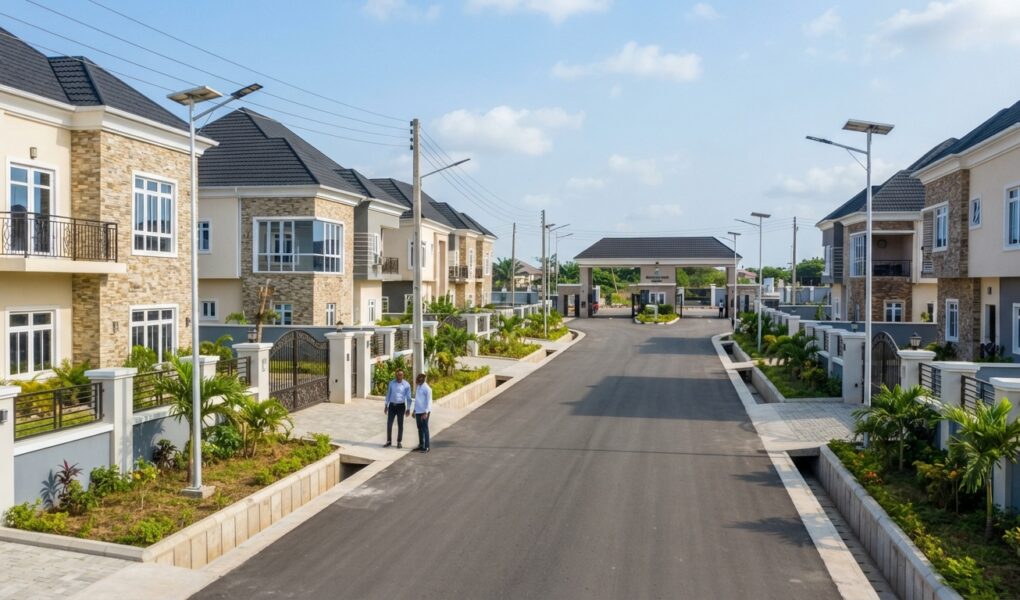
Check whether the roads are properly constructed, adequately surfaced, and wide enough for vehicles to pass conveniently.
Inspect road edges, speed bumps, junctions, pedestrian walkways, and access points.
Find out whether roads are fully completed or whether additional construction work is still planned.
Poorly constructed roads can become muddy, eroded, or damaged during rainy seasons, potentially affecting residents’ movement and vehicle maintenance costs.
Also consider whether the estate has adequate parking spaces for residents and visitors.
6. Evaluate Security Arrangements
Security is an essential consideration when moving into a new residential estate.
Find out whether the estate has security guards, controlled entry and exit points, perimeter fencing, CCTV cameras, security lighting, and emergency response arrangements.
Observe how visitors are screened and whether residents have a reliable system for reporting security incidents.
Ask whether security personnel operate around the clock and whether residents contribute to security expenses through service charges.
A newly completed estate may have fewer residents than an established community, making it particularly important to understand how security arrangements are maintained during the early stages of occupation.
7. Confirm That Waste Management Is Organised
Waste disposal is another important issue that can affect the cleanliness and health of a residential estate.
Ask how residents dispose of household waste and whether the estate has a designated waste collection point.
Confirm whether waste collection services operate regularly and whether residents are required to pay separate charges.
Inspect communal areas to determine whether waste is being properly managed.
Poor waste management can attract rodents, insects, unpleasant odours, and other environmental problems.
Before moving in, make sure you understand the estate’s waste disposal rules and arrangements.
8. Check the Estate’s Internet and Telecommunications Coverage
Reliable internet connectivity is increasingly important for remote workers, students, business owners, and households that depend on digital services.
Check mobile network coverage within the estate and inside the property.
Ask neighbours or existing residents about the performance of major telecommunications providers.
Determine whether fibre-optic internet infrastructure is available or whether residents depend on mobile broadband.
A newly completed estate may have modern buildings but limited telecommunications infrastructure, which can become inconvenient for residents working from home.
9. Inspect Shared Facilities and Amenities
Many residential estates advertise facilities such as playgrounds, swimming pools, gyms, recreational centres, gardens, shops, and community spaces.
Before moving in, verify that the facilities advertised by the developer actually exist and are operational.
Check their condition, accessibility, safety, and maintenance arrangements.
Find out whether the use of these facilities is included in the estate’s service charges or requires additional payment.
If some amenities are still under construction, ask when they are expected to be completed and whether the timeline is documented.
Do not assume that every facility shown in promotional materials will be available immediately after moving in.
10. Understand Service Charges and Estate Rules
Living in a managed estate often involves additional financial obligations beyond rent or the purchase price of the property.
These may include security charges, waste management fees, water maintenance costs, electricity for communal areas, landscaping expenses, road maintenance, and administrative fees.
Ask for a clear breakdown of service charges and understand how frequently payments are required.
You should also request a copy of the estate’s rules and regulations.
These may cover noise restrictions, parking, pets, renovations, visitors, commercial activities, waste disposal, and the use of communal facilities.
Understanding these rules before moving in can help prevent disagreements with estate management or other residents.
11. Verify the Property Documentation
If you are purchasing a property in a newly completed estate, ensure that the relevant documentation is properly reviewed.
Depending on the nature of the development and the location, documents may include the purchase agreement, allocation letter, survey plan, title documents, approved building plans, receipts, and other relevant legal records.
Confirm that the developer has the legal authority to sell or allocate the property and that the documentation accurately identifies the property being purchased.
Where necessary, consult a qualified property lawyer to verify the title and review the transaction documents.
Do not rely solely on verbal assurances from sales representatives or promotional materials.
12. Observe the Estate’s Occupancy Level
The number of occupied houses can influence the experience of living in a newly completed estate.
An estate with only a few occupied properties may have limited commercial services, fewer active community facilities, and reduced social interaction.
Some shared facilities may not yet operate at full capacity, while service charges may be higher per resident if costs are distributed among a small number of occupants.
On the other hand, an estate with a growing population may gradually attract shops, schools, transport services, and other businesses.
Before moving in, consider whether the current occupancy level matches your expectations for convenience, privacy, community interaction, and lifestyle.
13. Check Access to Essential Services
A residential estate may be beautifully designed but inconveniently located if essential services are far away.
Consider the distance to hospitals, pharmacies, supermarkets, schools, banks, fuel stations, places of worship, and public transportation.
Check the availability of transportation during different periods of the day.
If you own a vehicle, evaluate the accessibility of major roads and the condition of the route leading to the estate.
If you depend on public transportation, determine whether taxis, buses, motorcycles, or other transport services are readily available.
Convenient access to essential services can significantly improve the overall living experience.
14. Ask About Ongoing Construction
Some newly completed estates continue to experience construction activities after residents begin moving in.
Additional houses, commercial buildings, roads, or facilities may still be under development.
Ask the estate management about ongoing and planned construction projects.
Find out whether construction activities are likely to affect noise levels, dust, traffic, parking, security, or access to certain parts of the estate.
If you are moving into a property close to an unfinished development, consider how these activities may affect your comfort over the next several months or years.
15. Document the Property’s Condition Before Taking Possession
Before moving your belongings into the property, document its condition.
Take photographs and videos of walls, ceilings, floors, doors, windows, bathrooms, kitchens, electrical fittings, plumbing installations, and any existing defects.
Prepare a written list of problems that require attention.
If you are renting, share the inspection report with the landlord or property manager and keep a copy for your records.
If you are buying directly from a developer, request that outstanding defects be documented and addressed according to the applicable agreement and handover process.
Proper documentation can help prevent disagreements about responsibility for repairs after occupation.
Conclusion
Moving into a newly completed estate requires more than checking whether the house looks attractive and the keys are ready for collection.
Residents should carefully evaluate the building’s construction quality, water supply, electricity, drainage, roads, security, waste management, telecommunications, shared facilities, service charges, property documentation, and access to essential services.
A thorough inspection before moving in can help identify problems early, reduce unexpected expenses, and provide a clearer understanding of what to expect from the estate’s management and infrastructure.
Whether you are renting, buying your first home, or investing in residential property, taking these precautions can help ensure that your new estate offers not just a beautiful house, but a comfortable, safe, and practical place to live.