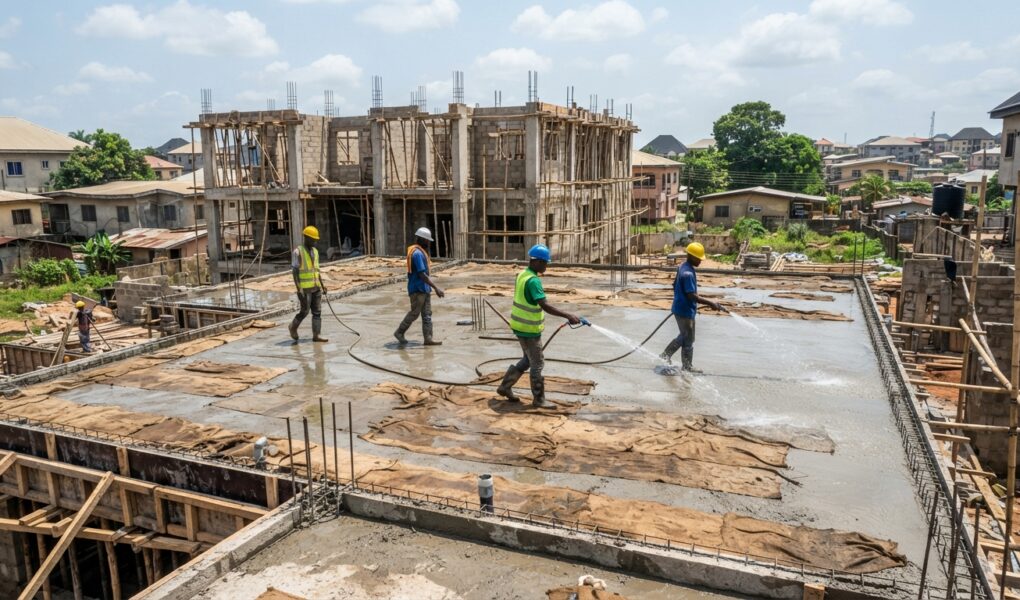
When building a house, most property owners pay close attention to the quality of cement, sand, granite, reinforcement bars and other construction materials. They also monitor the workmanship of builders and the progress of the building project. However, one important construction activity that is sometimes neglected is concrete curing.
Concrete curing plays a major role in determining the strength, durability and long-term performance of a building. Whether you are constructing a bungalow, duplex, apartment building or commercial property, ensuring that concrete is properly cured can help prevent avoidable construction defects and expensive repairs.
Unfortunately, some contractors rush to the next stage of construction immediately after pouring concrete without giving sufficient attention to curing. This can affect the quality of structural components and potentially create problems that property owners may only discover years later.
Understanding why proper concrete curing matters can help you make better construction decisions and protect your real estate investment.
What Is Concrete Curing?
Concrete curing is the process of maintaining adequate moisture and suitable temperature conditions in freshly placed concrete to allow the cement hydration process to continue.
When cement is mixed with water, sand and granite, a chemical reaction known as hydration begins. This reaction gradually produces compounds that bind the materials together and give concrete its strength.
However, concrete does not achieve its intended strength immediately after pouring. It needs sufficient time and appropriate conditions for hydration to progress.
Proper curing helps prevent freshly placed concrete from losing moisture too quickly, allowing it to develop the strength and durability required for construction.
This is particularly important for foundations, columns, beams, suspended slabs, staircases and other reinforced concrete components.
1. Proper Curing Helps Concrete Develop Its Required Strength
One of the biggest reasons concrete curing is important is its contribution to concrete strength.
A building depends on properly designed and constructed structural components to carry its weight and withstand the loads placed on it.
When concrete is adequately cured, cement hydration continues, helping the concrete develop its intended compressive strength.
However, when freshly poured concrete loses moisture too quickly, hydration may be restricted, particularly near the surface. This can result in weaker concrete than expected.
For property owners, this means that using good-quality cement and the correct concrete mix is not enough. Proper curing is equally important.
Always ensure that your contractor follows the curing requirements specified by the structural engineer.
2. It Helps Prevent Cracks in Concrete
Concrete cracks can become a serious concern during house construction, particularly when the causes are not identified and addressed early.
One common cause of early-age cracking is rapid moisture loss from freshly poured concrete.
When concrete dries too quickly, shrinkage can occur. If the resulting stresses exceed the concrete’s ability to resist them, cracks may develop.
This is particularly common under conditions involving:
- High temperatures.
- Direct exposure to sunlight.
- Strong winds.
- Inadequate moisture protection.
- Poor concrete placement practices.
In Nigeria, where buildings are frequently constructed under hot weather conditions, protecting freshly poured concrete from rapid drying is particularly important.
Proper curing helps maintain moisture and reduces the risk of early-age drying shrinkage.
However, curing cannot eliminate every type of crack. Structural movement, settlement, poor reinforcement detailing and inappropriate concrete mixes can also contribute to cracking.
3. It Improves the Durability of Your Building
A good building should remain structurally sound and functional for many years.
Proper concrete curing contributes to durability by allowing the concrete to develop a denser internal structure with reduced permeability.
This makes it more difficult for water and harmful substances to penetrate the concrete.
Without adequate curing, concrete may become more porous, increasing its vulnerability to environmental deterioration.
This is especially important for properties exposed to heavy rainfall, persistent moisture, groundwater or coastal conditions.
For homeowners and property investors, better concrete durability means reducing the likelihood of premature deterioration and unnecessary maintenance expenses.
4. It Helps Protect Reinforcement Bars From Corrosion
Reinforcement bars, commonly called iron rods, are important components of reinforced concrete construction.
They provide tensile strength and help structural elements such as beams, columns, foundations and slabs withstand different types of loading.
Concrete normally provides a protective environment around embedded reinforcement bars. However, when concrete becomes excessively permeable, moisture and harmful substances can penetrate more easily.
In coastal locations, exposure to chlorides can increase the risk of reinforcement corrosion.
Proper curing contributes to concrete density and helps reduce permeability, supporting the protection of reinforcement steel.
Nevertheless, curing alone cannot prevent corrosion. Correct concrete cover, appropriate mix design, good compaction and proper structural detailing are also necessary.
5. It Prevents Weak and Dusty Concrete Surfaces
Have you ever visited a property where the concrete floor produces dust whenever people walk over it?
A weak concrete surface may be associated with inadequate curing, poor finishing practices, excessive water in the concrete mix or other workmanship problems.
When the surface of freshly placed concrete loses moisture too quickly, it may not develop adequate surface strength.
This can lead to:
- Excessive surface dust.
- Premature wearing.
- Surface scaling.
- Reduced resistance to abrasion.
- Poor performance under everyday use.
Proper curing helps improve surface quality and makes concrete more suitable for areas that experience frequent movement, including driveways, parking spaces, walkways and residential floors.
6. It Helps Concrete Perform Better Under Nigerian Weather Conditions
Weather conditions have a significant influence on concrete construction.
High temperatures and strong sunlight can accelerate moisture evaporation, while heavy rainfall can damage freshly placed concrete if it is not adequately protected.
For property owners building in Nigeria, these environmental conditions should be considered when planning concrete works.
During hot weather, contractors should take precautions to prevent excessive moisture loss.
During rainfall, freshly placed concrete should be protected against erosion and surface damage.
The curing method should also be appropriate for the prevailing weather conditions and the type of structural component being constructed.
A contractor who understands proper concrete curing will be better prepared to manage these challenges.
7. It Reduces Future Building Maintenance Costs
One of the biggest mistakes property owners can make is concentrating only on the initial cost of construction without considering the long-term cost of maintaining the property.
Poor concrete curing can contribute to defects that may require expensive repairs.
Depending on the severity of the problem, these may include surface repairs, crack treatment, waterproofing interventions or more extensive structural rehabilitation.
For landlords and real estate investors, such problems can affect rental income, tenant satisfaction and the overall value of a property.
Proper curing is relatively inexpensive compared with the potential cost of correcting serious concrete defects.
Spending time and resources on this construction stage can therefore be a sensible way to protect your investment.
Common Methods of Concrete Curing
There are several methods used to cure concrete. The appropriate method depends on the type of construction, weather conditions and project specifications.
1. Water Curing
Water curing involves maintaining moisture on the concrete surface.
Common techniques include:
- Sprinkling water regularly over the concrete.
- Creating small water-retaining areas on concrete slabs.
- Covering concrete with wet hessian or other suitable damp materials.
This method is commonly used in residential construction.
2. Plastic Sheet Curing
Concrete can be covered with polyethylene sheets to reduce moisture evaporation.
The sheets should cover the concrete properly, with edges secured to prevent wind from exposing the surface.
Where necessary, the concrete should be sufficiently moist before the covering is applied.
3. Wet Covering Method
Materials such as clean hessian or burlap can be placed over concrete and kept continuously damp.
This method is useful for concrete slabs and other exposed surfaces.
4. Curing Compounds
Special curing compounds can be applied to concrete to form a protective membrane that reduces moisture loss.
These products can be useful when continuous water curing is difficult.
However, the contractor should ensure that the selected curing compound is compatible with any subsequent coating, waterproofing or finishing materials.
How Long Should Concrete Be Cured?
The required curing period depends on several factors, including cement type, concrete mix, environmental conditions and the structural requirements of the project.
For ordinary Portland cement concrete under suitable conditions, seven days of continuous moist curing is a commonly used minimum practical guideline.
However, some concrete mixtures and construction conditions require longer curing periods. Ten to fourteen days or more may be specified depending on the project requirements.
It is important to understand that concrete continues gaining strength beyond the initial curing period.
The commonly referenced 28-day concrete strength is a standard testing benchmark. It does not mean that concrete stops developing strength after 28 days.
Property owners should ask their structural engineer to specify the appropriate curing duration rather than allowing workers to decide when curing should stop.
Common Concrete Curing Mistakes Property Owners Should Watch Out For
Even when good-quality materials are used, mistakes during curing can affect the final concrete quality.
Here are some common mistakes to avoid:
1. Allowing freshly poured concrete to dry too quickly
Concrete should not be left exposed to intense sunlight and strong winds without appropriate moisture protection.
2. Watering concrete irregularly
Occasionally pouring water over concrete and allowing it to dry completely between watering sessions may undermine effective moist curing.
3. Stopping curing too early
Ending curing after only two or three days may be inadequate for many concrete applications.
4. Using unsuitable water
Water used for curing should be clean and suitable for concrete. Contaminated water containing harmful substances should be avoided.
5. Assuming rainfall replaces proper curing
Rain does not automatically provide effective curing. Fresh concrete still needs appropriate protection and moisture management.
6. Allowing premature construction activities
Heavy loads and construction activities should not be introduced until the concrete has achieved sufficient strength for the intended purpose.
Practical Tips for Homeowners Building in Nigeria
If you are building a house, you do not need to be a structural engineer to monitor whether basic concrete curing practices are being followed.
Here are some practical steps you can take:
- Discuss the concrete curing plan with your contractor before major concrete works begin.
- Ensure that freshly poured concrete is protected against excessive moisture loss.
- Confirm that water used for curing is clean.
- Check that exposed concrete surfaces remain adequately moist throughout the specified curing period.
- Pay particular attention to roof slabs, foundations, beams and columns.
- Ask your structural engineer about the appropriate curing duration for each concrete component.
- Ensure that workers do not remove protective coverings prematurely.
- Keep records of concrete pouring dates and curing activities.
- Do not allow contractors to compromise curing simply because they want to complete construction faster.
For large projects, especially buildings with suspended concrete slabs, a proper curing plan should form part of the construction schedule.
Frequently Asked Questions About Concrete Curing
Does pouring water on concrete make it stronger?
Water curing helps concrete develop its intended strength by maintaining moisture needed for cement hydration. However, adding excessive water to the concrete mixture during preparation can reduce its strength. These are two different activities.
Can concrete be left without curing?
Concrete may still harden without deliberate curing, but it may not achieve its intended strength and durability, particularly when exposed to rapid moisture loss. Appropriate curing should always be included in concrete construction.
Is seven days enough to cure concrete?
Seven days is a commonly used minimum practical guideline for ordinary Portland cement concrete under suitable conditions. Some projects require longer periods depending on the cement, mix design, weather and engineering specifications.
Should concrete be watered every day?
For conventional moist curing, the aim is to maintain continuous moisture rather than allowing the concrete to dry out between watering sessions. The exact method and frequency depend on the weather and curing arrangement.
Is concrete curing necessary for roof slabs?
Yes. Roof slabs are particularly exposed to sunlight, wind and high temperatures. Proper curing is essential to help them develop the required strength and durability.
Conclusion
Proper concrete curing is an important part of building construction that should never be ignored.
It helps concrete develop adequate strength, reduces the risk of early-age cracking, improves durability and contributes to protecting reinforcement bars from corrosion.
For homeowners, landlords, property developers and real estate investors in Nigeria, paying attention to concrete curing can help prevent avoidable construction defects and protect the long-term value of a property.
Before your next concrete pouring exercise, speak with your contractor and structural engineer about the appropriate curing method and duration.
Remember, building a durable house is not just about buying quality materials or hiring experienced workers. It is also about ensuring that every stage of construction is properly executed.