
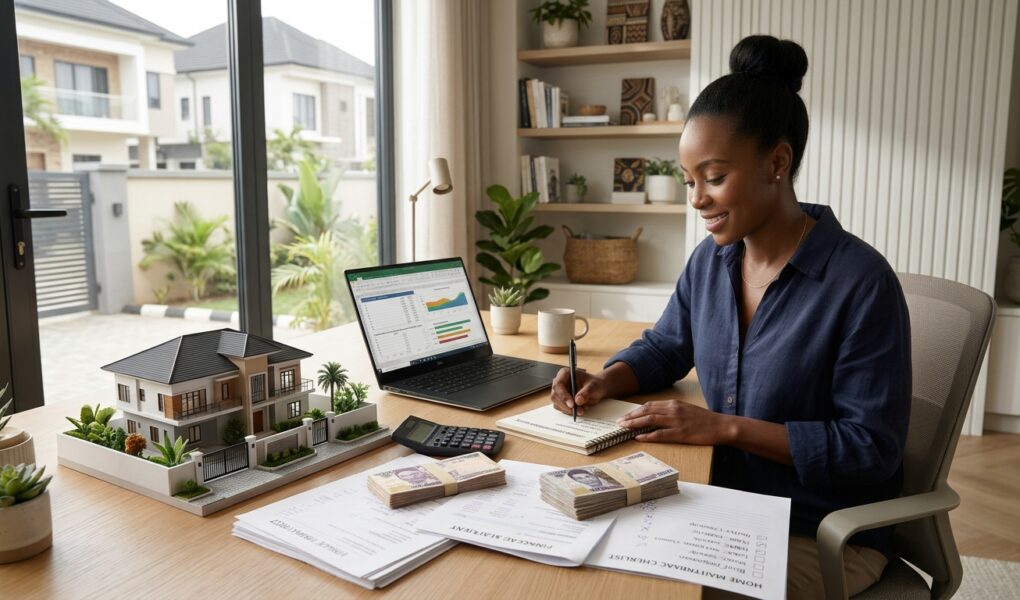
Buying a house or investing in land is a major financial milestone for many Nigerians. However, the financial responsibility of owning property does not end after paying the seller and collecting the keys. From property documentation and government charges to repairs, security, estate levies and rising maintenance costs, homeowners must prepare for several expenses that can continue for years.
Unfortunately, many Nigerian property buyers concentrate almost entirely on the purchase price without considering what it will cost to maintain and manage the property over time. This can create financial pressure, particularly when unexpected repairs arise or the cost of building materials and labour increases.
Preparing a realistic five-year property ownership budget helps you understand the financial commitment involved before purchasing a property. It also allows you to plan your income, protect your investment and avoid spending beyond your financial capacity.
Whether you are buying a house in Lagos, purchasing land in Ibadan, investing in Abuja or acquiring a residential property in another Nigerian city, a five-year ownership plan can help you make more informed financial decisions.
1. Calculate the Complete Cost of Acquiring the Property
Your property ownership budget should begin with the total amount required to complete the purchase.
The advertised selling price is not necessarily the final amount you will spend. Depending on the property, location and transaction arrangements, additional expenses may include:
- Legal fees and property agreement preparation.
- Estate agency or commission fees.
- Survey fees and verification.
- Land registry searches.
- Title documentation and registration.
- Governor’s Consent, where applicable.
- Deed of Assignment preparation and registration.
- Certificate of Occupancy processing, where applicable.
- Applicable government charges and statutory fees.
In Nigeria, property documentation can involve significant expenses. Buyers should understand whether the property has a Certificate of Occupancy, registered Deed of Assignment, Governor’s Consent or other relevant title documents.
The actual requirements depend on the property’s existing title and transaction history.
Before making payment, engage an independent property lawyer to investigate ownership, confirm the seller’s authority and explain the costs of perfecting the title.
Do not assume that a property is legally secure simply because the seller has presented documents or claims to have completed previous transactions.
2. Estimate Your Annual Property Maintenance Expenses
Every property requires maintenance, regardless of its age or purchase price.
In Nigeria, environmental conditions, rainfall, humidity, building quality and construction materials can influence how frequently a property needs repairs.
For example, properties in areas with heavy rainfall may require regular attention to roofing, drainage systems, ceilings and external walls.
Your maintenance budget should consider:
- Roof inspection and repairs.
- Plumbing and bathroom fittings.
- Electrical installations.
- Painting and wall treatment.
- Water tanks and pumping machines.
- Drainage and soakaway maintenance.
- Doors, windows and security fittings.
- General structural inspections.
- Septic tanks and sewage systems.
Do not wait until a major problem develops before allocating money for maintenance.
A small roof leak, for example, can eventually damage ceilings, electrical installations and interior walls if ignored.
The amount you reserve should depend on the building’s age, size, construction quality and current condition.
3. Include Estate Management Fees and Community Levies
If you purchase property within a managed estate, find out how much residents are expected to contribute towards common services.
Many Nigerian residential estates collect service charges or periodic contributions to finance shared facilities.
These expenses may cover:
- Estate security personnel.
- Streetlight maintenance.
- Waste collection.
- Road maintenance.
- Cleaning of common areas.
- Landscaping.
- Water supply infrastructure.
- Maintenance of drainage channels.
- Management and administrative services.
Some estates collect monthly charges, while others operate quarterly or annual payment arrangements.
Before purchasing, request the current service charge schedule and ask whether residents have outstanding contributions.
You should also investigate whether the estate management has plans to increase service charges.
An affordable property in an estate with expensive recurring levies may become financially demanding over time.
4. Budget for Electricity, Water and Other Utilities
Utility expenses are another important part of property ownership in Nigeria.
Depending on your location and the available infrastructure, you may need to budget for:
- Electricity bills.
- Prepaid meter purchases or maintenance where applicable.
- Generator fuel.
- Generator servicing.
- Solar power system maintenance.
- Water bills.
- Borehole pumping costs.
- Water treatment.
- Internet subscriptions.
- Waste disposal.
For properties in areas with unreliable public electricity supply, generator fuel and alternative power arrangements can become significant recurring expenses.
If you intend to install solar power, include the initial installation cost, battery replacement considerations and routine system maintenance in your five-year plan.
Likewise, if your property depends on a private borehole, remember that pumping machines, storage tanks and water treatment equipment require occasional servicing or replacement.
5. Create a Dedicated Fund for Major Repairs and Renovations
Routine maintenance and major renovation projects should not be treated as the same expense.
A five-year ownership budget should identify improvements that may become necessary during the period.
For example, you may eventually need to:
- Replace damaged roofing sheets.
- Renovate bathrooms and kitchens.
- Replace ageing electrical installations.
- Upgrade the property’s security system.
- Repair cracked floors and damaged tiles.
- Repaint the entire building.
- Improve drainage around the property.
- Replace an ageing water pumping machine.
If you are purchasing an older property, consider commissioning a professional building inspection before completing the transaction.
A building that appears attractive during a viewing may have hidden problems involving its foundation, roof, plumbing or electrical systems.
Identifying these problems early helps you estimate the likely renovation expenses rather than discovering them after moving in.
6. Account for Property Taxes and Government Charges
Property owners in Nigeria should investigate the taxes, rates and statutory charges applicable to their properties.
Depending on the state, local regulations and nature of the property, these may include:
- Land use charges.
- Applicable tenement or property rates.
- Ground rent on relevant government land allocations.
- Waste management charges.
- Applicable development or infrastructure levies.
- Property-related statutory fees.
For example, Lagos has its Land Use Charge framework, while other states operate their own property-related revenue and land administration systems.
Do not assume that the charges applicable in Lagos will be identical to those in Oyo, Ogun, Abuja or Rivers State.
Contact the relevant state or local authorities to establish the actual obligations attached to your property.
Keep receipts and payment records to avoid unnecessary disputes or difficulties when selling or transferring the property in the future.
7. Consider the Cost of Property Security
Security is a major consideration for Nigerian homeowners, particularly in developing residential areas and estates with limited public infrastructure.
Depending on your location, you may need to invest in additional security measures such as:
- Perimeter fencing.
- Security gates.
- Burglar-proof windows.
- Security doors.
- CCTV cameras.
- Motion sensor lighting.
- Alarm systems.
- Access control systems.
- Private security arrangements.
Some homeowners also contribute towards neighbourhood security arrangements.
When preparing your budget, distinguish between one-time installation expenses and recurring security costs.
For instance, installing CCTV cameras is an initial expense, while maintaining the equipment, replacing damaged components and paying security personnel may create continuing financial obligations.
8. Factor in Inflation and Increasing Building Material Prices
One of the biggest challenges of long-term property ownership in Nigeria is the changing cost of building materials and construction services.
Prices of cement, iron rods, roofing sheets, tiles, plumbing materials, electrical fittings and skilled labour can change considerably over time.
A maintenance budget prepared using today’s prices may therefore become insufficient within two or three years.
Instead of assuming that your annual expenses will remain constant, include an allowance for inflation and possible increases in service charges.
For example, if you currently spend ₦500,000 annually on maintenance, you should not automatically assume that the same amount will cover your expenses five years later.
Use reasonable planning assumptions and review them regularly against actual market prices.
This is particularly important for homeowners who intend to undertake major renovations or additional construction work.
9. Prepare for Unexpected Property Expenses
Not every property expense can be predicted.
A sudden roof leak, damaged water pump, blocked drainage system, electrical fault or security incident may require immediate attention.
For this reason, establish a separate emergency property fund.
Your emergency reserve should reflect the size, age, condition and location of your building.
For instance, a newly completed house with functioning installations may require a different emergency reserve from an older property with ageing plumbing and electrical systems.
Avoid using this fund for furniture purchases, decorative improvements or other non-essential projects.
Its primary purpose is to ensure that unexpected property problems do not force you to borrow money or abandon important household financial commitments.
10. Include Mortgage Repayments and Financing Costs
If you purchased your property through a mortgage or another financing arrangement, include the repayment obligations in your five-year budget.
Consider:
- Monthly mortgage repayments.
- Interest charges.
- Applicable mortgage insurance.
- Bank processing fees.
- Legal and valuation expenses.
- Possible changes in interest rates.
- Early repayment conditions.
Nigerian property buyers should carefully examine the terms of their financing arrangements before committing to a purchase.
Do not calculate affordability using only the initial monthly repayment if the financing arrangement allows interest rates or other charges to change.
Your mortgage should remain manageable alongside utilities, maintenance, household expenses and other financial responsibilities.
11. If You Are a Landlord, Include Rental Management Expenses
Property ownership in Nigeria does not always mean personal residential use. Many buyers acquire houses and apartments specifically to generate rental income.
However, rental income should not be treated as pure profit.
Landlords need to budget for:
- Property management fees.
- Tenant sourcing and advertising.
- Agency and legal expenses.
- Property inspections.
- Repairs between tenancies.
- Painting and cleaning.
- Security and estate charges.
- Periods without tenants.
- Rent collection and administrative expenses.
For example, a landlord whose property generates ₦2 million in annual rent should not automatically consider the entire ₦2 million as disposable income.
Some of that money must be reserved for maintenance, management, taxes and possible vacancies.
If you live abroad or in another Nigerian state, consider the additional cost of appointing a reliable property manager to oversee the building.
12. Prepare a Five-Year Property Ownership Budget in Naira
Once you have identified your expected expenses, organise them into a five-year financial projection.
The following example illustrates how a Nigerian homeowner might estimate recurring property expenses.
Illustrative five-year budget for a residential property in Nigeria:
| Expense | Year 1 | Year 2 | Year 3 | Year 4 | Year 5 |
|---|---|---|---|---|---|
| Maintenance | ₦500,000 | ₦550,000 | ₦605,000 | ₦665,500 | ₦732,000 |
| Utilities | ₦600,000 | ₦660,000 | ₦726,000 | ₦799,000 | ₦879,000 |
| Security | ₦300,000 | ₦330,000 | ₦363,000 | ₦399,000 | ₦439,000 |
| Insurance | ₦150,000 | ₦165,000 | ₦182,000 | ₦200,000 | ₦220,000 |
| Repairs and upgrades | ₦400,000 | ₦500,000 | ₦700,000 | ₦600,000 | ₦900,000 |
| Annual total | ₦1,950,000 | ₦2,205,000 | ₦2,576,000 | ₦2,663,500 | ₦3,170,000 |
Projected five-year total: ₦12,564,500.
These figures are hypothetical planning examples, not official Nigerian property costs. Actual expenses will depend on the property’s location, size, condition, service arrangements and the homeowner’s lifestyle. They exclude the purchase price, acquisition documentation, mortgage repayments and applicable property taxes or government charges.
The purpose of this projection is to demonstrate how recurring property expenses can increase over time.
13. Review Your Property Budget Every Year
Your five-year budget should be reviewed regularly rather than treated as a fixed financial document.
At the end of each year:
- Compare actual spending with your original estimates.
- Identify expenses that increased unexpectedly.
- Review the condition of major building components.
- Update maintenance and renovation estimates.
- Check outstanding property-related charges.
- Reassess your emergency savings.
- Adjust future allocations to reflect current prices.
Maintain a digital or physical record of payments, receipts, repair invoices, insurance documents and property-related correspondence.
These records can help you understand how much you are spending on the property and provide useful evidence when resolving disputes or preparing for a future sale.
14. Avoid Committing All Your Savings to Buying the Property
A common mistake among Nigerian property buyers is exhausting their savings to complete a property purchase.
While owning a house is a significant achievement, it should not leave you financially vulnerable.
Before committing to a purchase, make sure you have considered the immediate costs of moving into the property, completing necessary documentation, installing essential facilities and carrying out urgent repairs.
You should also retain sufficient savings for household emergencies and other financial responsibilities.
If purchasing a particular property means you cannot afford to maintain it properly, consider whether a less expensive property would be a more sustainable decision.
The goal should not simply be to own a house. It should be to own a property that you can comfortably afford to maintain.
Final Thoughts
Preparing a realistic five-year property ownership budget is one of the smartest financial decisions Nigerian property buyers can make.
The true cost of owning a house goes beyond the amount paid to the seller. Documentation, maintenance, electricity, water, security, estate charges, taxes and unexpected repairs can create substantial financial obligations over time.
Whether you are buying your first home in Ibadan, acquiring an investment apartment in Lagos, purchasing a family house in Abuja or managing rental properties from abroad, proper financial planning can help you protect your investment.
Before buying, investigate the property’s condition, understand its recurring expenses and establish how much it will realistically cost to maintain over the next five years.
A property should be an asset you can enjoy and manage responsibly, not a financial burden that becomes more difficult to carry with every passing year.