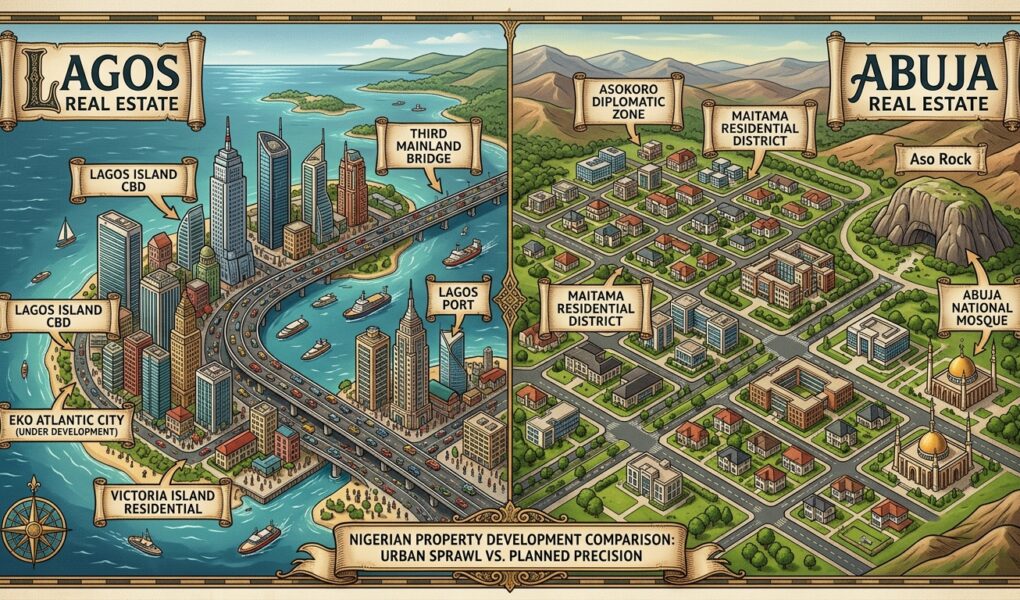
If you have enough money to invest in Nigerian real estate, two cities will almost always come up in the conversation:
Lagos or Abuja?
Lagos is Nigeria’s commercial powerhouse, with a huge population, strong business activity, extensive rental demand and a deep property market.
Abuja, on the other hand, is Nigeria’s capital and offers a more planned urban environment, strong demand from government workers, diplomats, businesses and professionals, and a different type of property market.
So, is it better to buy property in Lagos or Abuja?
The answer depends on what you want from the investment.
If your priority is short-let income, broad tenant demand, business-related property demand or access to a large and active market, Lagos may appeal to you.
If you prefer a more planned city, government and diplomatic demand, or certain rental-income opportunities, Abuja may be worth considering.
The important thing is not to ask only which city is better.
Ask:
Which city is better for the type of property investment I want to make?
Lagos vs Abuja: What Does the Market Look Like?
Lagos and Abuja are both major Nigerian real-estate markets, but they operate differently.
According to Nigeria Property Centre’s Q4 2026 market report, Lagos and Abuja both had a median asking sale price of approximately ₦350 million across the properties covered by the report. Abuja had a median annual asking rent of ₦13.5 million, compared with ₦13 million in Lagos.
However, the size of the markets is very different.
The same report recorded more than 108,000 Lagos listings, compared with just over 5,000 Abuja rental listings in its state-level data.
This matters because market depth can influence:
- Buyer demand
- Tenant demand
- Resale opportunities
- Property availability
- Investment strategies
- Price comparisons
Therefore, comparing the two cities using only average prices can be misleading.
1. Lagos Has a Much Larger Property Market
One of Lagos’s biggest advantages is the sheer size and diversity of its real-estate market.
The city has demand from:
- Entrepreneurs
- Corporate employees
- Young professionals
- Families
- Students
- Business travellers
- Expatriates
- Tourists
- Short-let guests
- Commercial businesses
- Nigerians living abroad
Different parts of Lagos serve different markets.
For example, the investment logic for a property in Lekki may be completely different from a property in Ikeja, Yaba, Surulere or Ikorodu.
This gives investors many options.
Why market size matters
A larger market can provide more potential buyers and tenants.
It can also provide more investment strategies.
You could potentially invest in:
- Student accommodation
- Affordable apartments
- Luxury apartments
- Family homes
- Short-let apartments
- Commercial property
- Office space
- Land
- Industrial property
- Mixed-use developments
Lagos is therefore particularly attractive to investors who want exposure to a broad property market.
2. Abuja Has a More Planned Urban Structure
Abuja is fundamentally different from Lagos.
As the Federal Capital Territory, its development has historically been guided by a planned urban structure and designated districts.
The FCT Administration’s Land Administration Department is responsible for the administration and management of land within the FCT, including processing allocations and issuing and registering rights of occupancy and land titles.
This doesn’t mean that every Abuja property is automatically safer or better.
You still need proper due diligence.
But the city’s planning structure is an important factor when evaluating property.
Areas such as:
- Maitama
- Asokoro
- Wuse
- Garki
- Jabi
- Life Camp
- Gwarinpa
- Guzape
serve different markets and have different investment characteristics.
3. Which City Has Higher Rental Demand?
Both cities have strong rental markets, but the sources of demand are different.
Lagos rental demand
Lagos rental demand is driven by its enormous commercial and economic activity.
People move to Lagos because of:
- Employment
- Business
- Education
- Entrepreneurship
- Trade
- Entertainment
- Technology
- Corporate opportunities
This creates demand across a very wide range of property types.
Abuja rental demand
Abuja has strong demand associated with:
- Federal government workers
- Diplomats
- International organisations
- Professionals
- Corporate employees
- Contractors
- Businesses
- Families
This gives Abuja a somewhat different tenant profile.
Neither market should be viewed as a single market.
The specific neighbourhood often matters more than the city name.
4. Which Is Better for Rental Income?
This is where the comparison becomes interesting.
Current Nigeria Property Centre data shows that some Abuja property categories have higher gross rental yields than comparable Lagos categories.
For example, its Q4 2026 figures show:
| Property Type | Abuja Gross Yield | Lagos Gross Yield |
|---|---|---|
| 2-bedroom | 7.5% | 5.0% |
| 3-bedroom | 6.67% | 6.8% |
| 4-bedroom | 5.81% | 6.43% |
| 5-bedroom | 5.0% | 6.67% |
These are gross indicative yields based on asking prices and asking rents, not guaranteed returns. They also do not account for expenses such as maintenance, service charges, agency fees or vacancy periods.
This shows why investors should avoid saying:
“Lagos always gives better returns.”
Or:
“Abuja always gives better returns.”
The answer depends on the specific property.
5. Lagos May Offer More Opportunities for Short-Let Investment
Lagos has a particularly diverse visitor and business economy.
That can create opportunities for short-let properties in suitable locations.
Short-let demand may come from:
- Business travellers
- Tourists
- Nigerians visiting from abroad
- Corporate visitors
- Event attendees
- People requiring temporary accommodation
Nigeria Property Centre’s Q4 2026 report recorded an asking short-let rate of about ₦150,000 per night in Lagos.
But don’t interpret that figure as guaranteed income.
A property listed at ₦150,000 per night does not necessarily generate ₦150,000 every night.
You still have to consider:
- Occupancy
- Platform fees
- Cleaning
- Electricity
- Internet
- Security
- Maintenance
- Management
- Furniture replacement
- Taxes and applicable charges
A ₦150,000 nightly rate means very little if the property remains empty.
6. Lagos May Have Greater Market Liquidity
Liquidity is important in real estate.
If you eventually need to sell your property, you want to know whether there are potential buyers for it.
Nigeria Property Centre’s Q4 2026 data recorded a median of approximately 69 days to sell in Lagos, compared with 97 days in Abuja, among transactions represented in its dataset.
This does not mean every Lagos property will sell faster than every Abuja property.
A poorly located Lagos property can remain unsold for a long time.
A well-priced Abuja property can sell quickly.
But the broader data illustrates the importance of market depth and liquidity.
7. Abuja Can Be Attractive for Traditional Rental Investment
If your primary objective is long-term rental income rather than short-let operations, Abuja deserves serious consideration.
Certain Abuja districts have strong demand from professionals, government workers, diplomatic missions and corporate organisations.
For example, Nigeria Property Centre’s Q4 2026 data places the gross yield for Abuja two-bedroom properties at approximately 7.5%, one of the highest figures in its comparison.
However, investors should look beyond the headline percentage.
Ask:
- How much does the property cost?
- What rent can it realistically generate?
- How much will maintenance cost?
- What are service charges?
- How long might it remain vacant?
- Who is the target tenant?
- How easy will it be to resell?
A high gross yield doesn’t automatically mean a high net return.
8. What About Land?
Land investment is another area where Lagos and Abuja differ considerably.
In Lagos, investors often look toward developing corridors where population growth, infrastructure and urban expansion could create future demand.
In Abuja, investors may look at areas experiencing expansion outside the established central districts.
But this is where you need to be extremely careful.
Don’t buy land simply because someone tells you:
“This area will soon become the next Lekki.”
Before buying land, investigate:
- Title
- Survey
- Government acquisition
- Zoning
- Accessibility
- Infrastructure
- Flooding
- Development restrictions
- Existing claims
- Future road plans
For Abuja specifically, the FCT’s Land Administration Department handles land administration, title registration and related processes.
Cheap land is not necessarily a good investment.
9. Lagos Has Higher Traffic and Infrastructure Challenges
One factor investors sometimes underestimate is accessibility.
A property may look attractive on a map but become less attractive to tenants if reaching it requires spending hours in traffic every day.
This can influence:
- Rental demand
- Property prices
- Tenant preferences
- Short-let demand
- Commercial activity
In Lagos, proximity to major roads, business districts and transport connections can be particularly important.
Two properties with similar prices can perform very differently simply because one is easier to reach.
10. Abuja’s Location Advantage Can Be Different
Abuja’s relatively planned road network and district structure can be attractive to some residents and businesses.
But Abuja also has its own challenges.
Some properties may be physically distant from major employment centres, while certain peripheral areas may take longer to develop.
This means you should not assume:
“Abuja is planned, so every property in Abuja is a good investment.”
It isn’t.
Location within the city still matters enormously.
11. Which City Is Better for Property Appreciation?
Property appreciation depends heavily on the individual location.
In Lagos, limited land availability in some established and highly demanded areas can support strong property values.
At the same time, emerging areas may provide opportunities for investors willing to wait for infrastructure and population growth.
Abuja also has developing districts and expanding residential areas.
The important question is:
What is driving future demand in this particular location?
Look for evidence such as:
- New roads
- Commercial developments
- New schools
- Hospitals
- Shopping centres
- Employment centres
- Population growth
- New estates
- Transport infrastructure
- Government development plans
Don’t buy land because someone says:
“Prices will double next year.”
Find out what is actually going to make prices increase.
12. Which City Is Better for a First-Time Investor?
This depends on your budget and investment strategy.
A beginner should not choose Lagos simply because it is the bigger market.
Likewise, you should not choose Abuja simply because it is the capital.
Instead, start with your investment objective.
If you want short-let income
Consider suitable Lagos locations, but carefully calculate occupancy and operating expenses.
If you want traditional rental income
Compare specific Lagos and Abuja properties based on net rental yield rather than city reputation.
If you want long-term land appreciation
Focus on emerging locations with genuine infrastructure and population growth.
If you want commercial property
Study where businesses and employment are concentrating.
If you want a family home
Your decision should be based heavily on lifestyle, commute, schools, security, infrastructure and affordability—not just investment potential.
Lagos vs Abuja: A Simple Comparison
| Factor | Lagos | Abuja |
|---|---|---|
| Market size | Very large | Smaller |
| Commercial activity | Very strong | Strong |
| Rental demand | Very broad | Strong in key areas |
| Short-let potential | Strong in suitable locations | Strong in suitable locations |
| Government-related demand | Moderate | Very strong |
| Property market depth | Very high | Moderate |
| Traffic challenge | High in many areas | Generally lower, but location matters |
| Planned urban structure | Less uniform | More planned |
| Investment options | Very diverse | Diverse |
| Gross rental yield | Varies by property | Some categories currently stronger |
| Resale liquidity | Generally deeper | Can vary significantly by area |
| Land opportunities | Strong in growth corridors | Strong in expansion areas |
| Entry cost | High in prime areas | High in prime areas |
Should You Buy in Lagos or Abuja?
Instead of trying to find a universal winner, use this approach.
Choose Lagos if your strategy is focused on:
- A large and diverse tenant market
- Business-driven property demand
- Short-let opportunities
- High market liquidity
- Commercial real estate
- Established and emerging growth corridors
- A wide range of property investment options
Consider Abuja if your strategy is focused on:
- Traditional rental income
- Government and diplomatic tenant demand
- Planned districts
- Professional and corporate tenants
- Selected high-yield residential properties
- Long-term residential investment
These are not absolute rules.
The specific property can matter more than the city.
What If You Can Afford Property in Both Cities?
If your finances allow it, diversification across both markets could be worth considering.
For example, an investor might own:
- A rental apartment in Abuja
- A short-let property in Lagos
- Land in a carefully selected growth corridor
But don’t buy in both cities simply for the sake of diversification.
Every property should still pass your investment test.
Ask:
What is this property expected to do for my portfolio?
The Most Important Question: What Is Your Budget?
A ₦30 million investor and a ₦500 million investor should not receive the same property advice.
Your budget determines:
- Location
- Property type
- Financing requirements
- Expected rental income
- Development opportunities
- Risk level
- Investment horizon
Don’t stretch yourself financially just to buy in a prestigious location.
A smaller property that you can comfortably afford may be a better investment than a luxury property that puts you under financial pressure.
Do Your Due Diligence in Either City
Whether you choose Lagos or Abuja, never skip property verification.
Before buying, investigate:
- Ownership
- Title
- Survey
- Government acquisition
- Planning restrictions
- Building approvals
- Existing mortgages or encumbrances
- Litigation
- Physical boundaries
- Access
- Drainage
- Flooding
- Infrastructure
- Neighbourhood development
For Abuja, the FCT Land Administration Department is responsible for land administration and title registration within the FCT.
For Lagos, use the appropriate state processes and qualified professionals to verify the property’s title and transaction requirements.
Final Verdict: Lagos or Abuja?
There is no universal answer to “Is Lagos better than Abuja for property investment?”
The better question is:
“Which city offers the right property for my investment strategy, budget and financial goals?”
Lagos has the advantage of a much deeper and broader property market, significant commercial activity and strong demand across multiple property segments.
Abuja offers a different proposition, including strong government-linked and professional demand, planned districts and some attractive rental-yield opportunities.
Current market data shows that the two cities can have similar headline property prices while producing different rental yields and liquidity characteristics.
So don’t buy because someone says:
“Lagos is the future.”
And don’t buy simply because:
“Abuja is the capital.”
Study the specific property.
Study the location.
Study the numbers.
Study the title.
And most importantly, buy according to your investment strategy—not somebody else’s opinion.